
Java Cryptography Architecture (JCA) - JDK 5 Documentation v6.0, Java 2 SDK 英文文档
Java ™
Cryptography Architecture
(JCA) Reference Guide
for JavaTM Platform Standard Edition 6
Design Principles
Architecture
JCA Concepts
TheHow the JCA Might Be Used in a SSL/TLS ImplementationProviderClass
How Provider Implementations are Requested and SuppliedThe
Installing Providers
SecurityClass
TheSecureRandomClass
TheMessageDigestClass
TheSignatureClass
TheCipherClass
OtherCipher-based Classes
The Cipher Stream ClassesThe
TheTheCipherInputStreamClass
TheCipherOutputStreamClass
SealedObjectClass
MacClass
KeyInterfaces
TheKeyPairClass
KeySpecification Interfaces and Classes
TheOf Factories and GeneratorsKeySpecInterface
TheKeySpecSubinterfaces
TheEncodedKeySpecClass
ThePKCS8EncodedKeySpecClass
TheX509EncodedKeySpecClass
TheKeyFactoryClass
TheSecretKeyFactoryClass
TheKeyPairGeneratorClass
TheKeyGeneratorClass
TheKeyAgreementClass
Key Management
Keystore LocationAlgorithm Parameters Classes
Keystore Implementation
TheKeyStoreClass
TheTheAlgorithmParameterSpecInterface
TheAlgorithmParametersClass
TheAlgorithmParameterGeneratorClass
CertificateFactoryClass
How to Make Applications
"Exempt" from Cryptographic Restrictions
Computing aAppendix A: Standard NamesMessageDigestObject
Generating a Pair of Keys
Generating and Verifying a Signature Using Generated Keys
Generating/Verifying Signatures UsingKeySpecifications andKeyFactory
Determining If Two Keys Are Equal
Reading Base64-Encoded Certificates
Parsing a Certificate Reply
Using Encryption
Using Password-Based Encryption
Using Key Agreement
Appendix B: Jurisdiction Policy File Format
Appendix C: Maximum Key Sizes Allowed by "Strong" Jurisdiction Policy Files
Diffie-Hellman Key Exchange between 2 Parties
Diffie-Hellman Key Exchange between 3 Parties
Blowfish Cipher Example
HMAC-MD5 Example
Reading ASCII Passwords From an InputStream Example
Introduction
The Java platform strongly emphasizes security, including language safety, cryptography, public key infrastructure, authentication, secure communication, and access control.
The JCA is a major piece of the platform, and contains a "provider" architecture and a set of APIs for digital signatures, message digests (hashs), certificates and certificate validation, encryption (symmetric/asymmetric block/stream ciphers), key generation and management, and secure random number generation, to name a few. These APIs allow developers to easily integrate security into their application code. The architecture was designed around the following principles:
- Implementation independence
- Applications do not need to implement security algorithms. Rather, they can request security services from the Java platform. Security services are implemented in providers (see below), which are plugged into the Java platform via a standard interface. An application may rely on multiple independent providers for security functionality.
- Implementation interoperability
- Providers are interoperable across applications. Specifically, an application is not bound to a specific provider, and a provider is not bound to a specific application.
- Algorithm extensibility
- The Java platform includes a number of built-in providers that implement a basic set of security services that are widely used today. However, some applications may rely on emerging standards not yet implemented, or on proprietary services. The Java platform supports the installation of custom providers that implement such services.
Other cryptographic communication libraries available in the JDK use the JCA provider architecture, but are described elsewhere. The JavaTM Secure Socket Extension (JSSE) provides access to Secure Socket Layer (SSL) and Transport Layer Security (TLS) implementations. The Java Generic Security Services (JGSS) (via Kerberos) APIs, and the Simple Authentication and Security Layer (SASL) can also be used for securely exchanging messages between communicating applications.
Notes on Terminology
- Prior to JDK 1.4, the JCE was an unbundled product, and as such, the JCA and JCE were regularly referred to as separate, distinct components. As JCE is now bundled in the JDK, the distinction is becoming less apparent. Since the JCE uses the same architecture as the JCA, the JCE should be more properly thought of as a part of the JCA.
- The JCA within the JDK includes two software components:
- the framework that defines and supports cryptographic services for which providers supply implementations. This framework includes packages such as
java.security,javax.crypto,javax.crypto.spec, andjavax.crypto.interfaces.- the actual providers such as
Sun,SunRsaSign,SunJCE, which contain the actual cryptographic implementations.Whenever a specific JCA provider is mentioned, it will be referred to explicitly by the provider's name.
WARNING: The JCA makes it easy to incorporate security features into your application. However, this document does not cover the theory of security/cryptography beyond an elementary introduction to concepts necessary to discuss the APIs. This document also does not cover the strengths/weaknesses of specific algorithms, not does it cover protocol design. Cryptography is an advanced topic and one should consult a solid, preferably recent, reference in order to make best use of these tools.
You should always understand what you are doing and why: DO NOT simply copy random code and expect it to fully solve your usage scenario. Many applications have been deployed that contain significant security or performance problems because the wrong tool or algorithm was selected.
Design Principles
The JCA was designed around these principles:
- implementation independence and interoperability
- algorithm independence and extensibility
Implementation independence and algorithm independence are complementary; you can use cryptographic services, such as digital signatures and message digests, without worrying about the implementation details or even the algorithms that form the basis for these concepts. While complete algorithm-independence is not possible, the JCA provides standardized, algorithm-specific APIs. When implementation-independence is not desirable, the JCA lets developers indicate a specific implementation.
Algorithm independence is achieved by defining types of cryptographic "engines" (services), and defining classes that provide the functionality of these cryptographic engines. These classes are called engine classes, and examples are the
MessageDigest,Signature,KeyFactory,KeyPairGenerator, andCipherclasses.Implementation independence is achieved using a "provider"-based architecture. The term Cryptographic Service Provider (CSP) (used interchangeably with "provider" in this document) refers to a package or set of packages that implement one or more cryptographic services, such as digital signature algorithms, message digest algorithms, and key conversion services. A program may simply request a particular type of object (such as a
Signatureobject) implementing a particular service (such as the DSA signature algorithm) and get an implementation from one of the installed providers. If desired, a program may instead request an implementation from a specific provider. Providers may be updated transparently to the application, for example when faster or more secure versions are available.Implementation interoperability means that various implementations can work with each other, use each other's keys, or verify each other's signatures. This would mean, for example, that for the same algorithms, a key generated by one provider would be usable by another, and a signature generated by one provider would be verifiable by another.
Algorithm extensibility means that new algorithms that fit in one of the supported engine classes can be added easily.
Architecture
Cryptographic Service Providers
java.security.Provideris the base class for all security providers. Each CSP contains an instance of this class which contains the provider's name and lists all of the security services/algorithms it implements. When an instance of a particular algorithm is needed, the JCA framework consults the provider's database, and if a suitable match is found, the instance is created.Providers contain a package (or a set of packages) that supply concrete implementations for the advertised cryptographic algorithms. Each JDK installation has one or more providers installed and configured by default. Additional providers may be added statically or dynamically (see the Provider and Security classes). Clients may configure their runtime environment to specify the provider preference order. The preference order is the order in which providers are searched for requested services when no specific provider is requested.
To use the JCA, an application simply requests a particular type of object (such as a
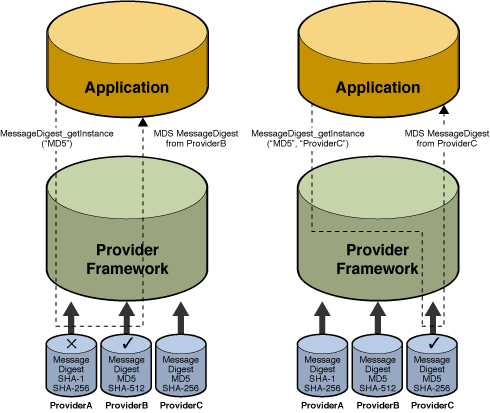
MessageDigest) and a particular algorithm or service (such as the "MD5" algorithm), and gets an implementation from one of the installed providers. Alternatively, the program can request the objects from a specific provider. Each provider has a name used to refer to it.md = MessageDigest.getInstance("MD5"); md = MessageDigest.getInstance("MD5", "ProviderC");The following figure illustrates requesting an "MD5" message digest implementation. The figure show three different providers that implement various message digest algorithms ("SHA-1", "MD5", "SHA-256", and "SHA-256"). The providers are ordered by preference from left to right (1-3). In the first illustration, an application requests an MD5 algorithm implementation without specifying a provider name. The providers are searched in preference order and the implementation from the first provider supplying that particular algorithm, ProviderB, is returned. In the second figure, the application requests the MD5 algorithm implementation from a specific provider, ProviderC. This time the implementation from ProviderC is returned, even though a provider with a higher preference order, ProviderB, also supplies an MD5 implementation.
Cryptographic implementations in the Sun JDK are distributed via several different providers (
Sun,SunJSSE,SunJCE,SunRsaSign) primarily for historical reasons, but to a lesser extent by the type of functionality and algorithms they provide. Other Java runtime environments may not necessarily contain these Sun providers, so applications should not request an provider-specific implementation unless it is known that a particular provider will be available.The JCA offers a set of APIs that allow users to query which providers are installed and what services they support.
This architecture also makes it easy for end-users to add additional providers. Many third party provider implementations are already available. See The
ProviderClass for more information on how providers are written, installed, and registered.How Providers Are Actually Implemented
As mentioned earlier, algorithm independence is achieved by defining a generic high-level Application Programming Interface (API) that all applications use to access a service type. Implementation independence is achieved by having all provider implementations conform to well-defined interfaces. Instances of engine classes are thus "backed" by implementation classes which have the same method signatures. Application calls are routed through the engine class and are delivered to the underlying backing implementation. The implementation handles the request and return the proper results.
The application API methods in each engine class are routed to the provider's implementations through classes that implement the corresponding Service Provider Interface (SPI). That is, for each engine class, there is a corresponding abstract SPI class which defines the methods that each cryptographic service provider's algorithm must implement. The name of each SPI class is the same as that of the corresponding engine class, followed by
Spi. For example, theSignatureengine class provides access to the functionality of a digital signature algorithm. The actual provider implementation is supplied in a subclass ofSignatureSpi. Applications call the engine class' API methods, which in turn call the SPI methods in the actual implementation.Each SPI class is abstract. To supply the implementation of a particular type of service for a specific algorithm, a provider must subclass the corresponding SPI class and provide implementations for all the abstract methods.
For each engine class in the API, implementation instances are requested and instantiated by calling the
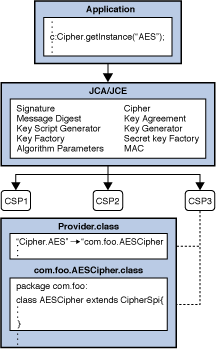
getInstance()factory method in the engine class. A factory method is a static method that returns an instance of a class. The engine classes use the framework provider selection mechanism described above to obtain the actual backing implementation (SPI), and then creates the actual engine object. Each instance of the engine class encapsulates (as a private field) the instance of the corresponding SPI class, known as the SPI object. All API methods of an API object are declared final and their implementations invoke the corresponding SPI methods of the encapsulated SPI object.To make this clearer, review the following code and illustration:
    import javax.crypto.*;

    Cipher c = Cipher.getInstance("AES");
    c.init(ENCRYPT_MODE, key);
Here an application wants an "AES"
javax.crypto.Cipherinstance, and doesn't care which provider is used. The application calls thegetInstance()factory methods of theCipherengine class, which in turn asks the JCA framework to find the first provider instance that supports "AES". The framework consults each installed provider, and obtains the provider's instance of theProviderclass. (Recall that theProviderclass is a database of available algorithms.) The framework searches each provider, finally finding a suitable entry in CSP3. This database entry points to the implementation classcom.foo.AESCipherwhich extendsCipherSpi, and is thus suitable for use by theCipherengine class. An instance ofcom.foo.AESCipheris created, and is encapsulated in a newly-created instance ofjavax.crypto.Cipher, which is returned to the application. When the application now does theinit()operation on theCipherinstance, theCipherengine class routes the request into the correspondingengineInit()backing method in thecom.foo.AESCipherclass.Appendix A lists the Standard Names defined for the Java environment. Other third-party providers may define their own implementations of these services, or even additional services.
Key Management
A database called a "keystore" can be used to manage a repository of keys and certificates. Keystores are available to applications that need data for authentication, encryption, or signing purposes.
Applications can access a keystore via an implementation of the
KeyStoreclass, which is in thejava.securitypackage. A defaultKeyStoreimplementation is provided by Sun Microsystems. It implements the keystore as a file, using a proprietary keystore type (format) named "jks". Other keystore formats are available, such as "jceks" which is an alternate proprietary keystore format with much stronger encryption than "jks", and "pkcs12", which is based on the RSA PKCS12 Personal Information Exchange Syntax Standard.Applications can choose different keystore implementations from different providers, using the same provider mechanism described above.
See the Key Management section for more information.
JCA Concepts
This section introduces the major JCA APIs.
Engine Classes and Algorithms
An engine class provides the interface to a specific type of cryptographic service, independent of a particular cryptographic algorithm or provider. The engines either provide:
- cryptographic operations (encryption, digital signatures, message digests, etc.),
- generators or converters of cryptographic material (keys and algorithm parameters), or
- objects (keystores or certificates) that encapsulate the cryptographic data and can be used at higher layers of abstraction.
The following engine classes are available:
SecureRandom: used to generate random or pseudo-random numbers.
MessageDigest: used to calculate the message digest (hash) of specified data.
Signature: initilialized with keys, these are used to sign data and verify digital signatures.
Cipher: initialized with keys, these used for encrypting/decrypting data. There are various types of algorithms: symmetric bulk encryption (e.g. AES, DES, DESede, Blowfish, IDEA), stream encryption (e.g. RC4), asymmetric encryption (e.g. RSA), and password-based encryption (PBE).
- Message Authentication Codes (MAC): like
MessageDigests, these also generate hash values, but are first initialized with keys to protect the integrity of messages.
KeyFactory: used to convert existing opaque cryptographic keys of typeKeyinto key specifications (transparent representations of the underlying key material), and vice versa.
SecretKeyFactory: used to convert existing opaque cryptographic keys of typeSecretKeyinto key specifications (transparent representations of the underlying key material), and vice versa.SecretKeyFactorys are specializedKeyFactorys that create secret (symmetric) keys only.
KeyPairGenerator: used to generate a new pair of public and private keys suitable for use with a specified algorithm.
KeyGenerator: used to generate new secret keys for use with a specified algorithm.
KeyAgreement: used by two or more parties to agree upon and establish a specific key to use for a particular cryptographic operation.
AlgorithmParameters: used to store the parameters for a particular algorithm, including parameter encoding and decoding.
AlgorithmParameterGenerator: used to generate a set of AlgorithmParameters suitable for a specified algorithm.
KeyStore: used to create and manage a keystore. A keystore is a database of keys. Private keys in a keystore have a certificate chain associated with them, which authenticates the corresponding public key. A keystore also contains certificates from trusted entities.
CertificateFactory: used to create public key certificates and Certificate Revocation Lists (CRLs).
CertPathBuilder: used to build certificate chains (also known as certification paths).
CertPathValidator: used to validate certificate chains.
CertStore: used to retrieveCertificates andCRLs from a repository.
NOTE: A generator creates objects with brand-new contents, whereas a factory creates objects from existing material (for example, an encoding).
Core Classes and Interfaces
This section discusses the core classes and interfaces provided in the JCA:
The guide will cover the most useful high-level classes first (
- the
ProviderandSecurityclasses,
- the
SecureRandom,MessageDigest,Signature,Cipher,Mac,KeyFactory,SecretKeyFactory,KeyPairGenerator,KeyGenerator,KeyAgreement,AlgorithmParameters,AlgorithmParameterGenerator,KeyStore, andCertificateFactory, engine classes,
- the
Keyinterfaces and classes,
- the Algorithm Parameter Specification Interfaces and Classes and the Key Specification Interfaces and Classes, and
- miscellaneous support and convenience interfaces and classes.
NOTE: For more information on theCertPathBuilder,CertPathValidator, andCertStoreengine classes, please see the Java(TM) PKI Programmer's Guide.
Provider,Security,SecureRandom,MessageDigest,Signature,Cipher, andMac), then delve into the various support classes. For now, it is sufficient to simply say that Keys (public, private, and secret) are generated and represented by the various JCA classes, and are used by the high-level classes as part of their operation.This section shows the signatures of the main methods in each class and interface. Examples for some of these classes (
MessageDigest,Signature,KeyPairGenerator,SecureRandom,KeyFactory, and key specification classes) are supplied in the corresponding Examples sections.The complete reference documentation for the relevant Security API packages can be found in the package summaries:
The
ProviderClassThe term "Cryptographic Service Provider" (used interchangeably with "provider" in this document) refers to a package or set of packages that supply a concrete implementation of a subset of the JDK Security API cryptography features. The
Providerclass is the interface to such a package or set of packages. It has methods for accessing the provider name, version number, and other information. Please note that in addition to registering implementations of cryptographic services, theProviderclass can also be used to register implementations of other security services that might get defined as part of the JDK Security API or one of its extensions.To supply implementations of cryptographic services, an entity (e.g., a development group) writes the implementation code and creates a subclass of the
Providerclass. The constructor of theProvidersubclass sets the values of various properties; the JDK Security API uses these values to look up the services that the provider implements. In other words, the subclass specifies the names of the classes implementing the services.
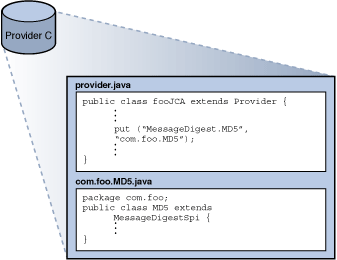
There are several types of services that can be implemented by provider packages; for more information, see Engine Classes and Algorithms.
The different implementations may have different characteristics. Some may be software-based, while others may be hardware-based. Some may be platform-independent, while others may be platform-specific. Some provider source code may be available for review and evaluation, while some may not. The JCA lets both end-users and developers decide what their needs are.
In this section we explain how end-users install the cryptography implementations that fit their needs, and how developers request the implementations that fit theirs.
NOTE: For information about implementing a provider, see the guide How To Implement a Provider for the Java Cryptography Architecture.
How Provider Implementations Are Requested and Supplied
For each engine class in the API, a implementation instance is requested and instantiated by calling one of thegetInstancemethods on the engine class, specifying the name of the desired algorithm and, optionally, the name of the provider (or theProviderclass) whose implementation is desired.where EngineClassName is the desired engine type (MessageDigest/Cipher/etc). For example:static EngineClassName getInstance(String algorithm) throws NoSuchAlgorithmException static EngineClassName getInstance(String algorithm, String provider) throws NoSuchAlgorithmException, NoSuchProviderException static EngineClassName getInstance(String algorithm, Provider provider) throws NoSuchAlgorithmExceptionMessageDigest md = MessageDigest.getInstance("MD5"); KeyAgreement ka = KeyAgreement.getInstance("DH", "SunJCE");return an instance of the "MD5" MessageDigest and "DH" KeyAgreement objects, respectively.Appendix A contains the list of names that have been standardized for use with the Java environment. Some providers may choose to also include alias names that also refer to the same algorithm. For example, the "SHA-1" algorithm might be referred to as "SHA1". Applications should use standard names instead of an alias, as not all providers may alias algorithm names in the same way.
NOTE: The algorithm name is not case-sensitive. For example, all the following calls are equivalent:MessageDigest.getInstance("SHA-1") MessageDigest.getInstance("sha-1") MessageDigest.getInstance("sHa-1")
If no provider is specified,
getInstancesearches the registered providers for an implementation of the requested cryptographic service associated with the named algorithm. In any given Java Virtual Machine (JVM), providers are installed in a given preference order, the order in which the provider list is searched if a specific provider is not requested. For example, suppose there are two providers installed in a JVM,PROVIDER_1andPROVIDER_2. Assume that:Now let's look at three scenarios:
PROVIDER_1implements SHA1withDSA, SHA-1, MD5, DES, and DES3.
PROVIDER_1has preference order 1 (the highest priority).
PROVIDER_2implements SHA1withDSA, MD5withRSA, MD2withRSA, MD2, MD5, RC4, RC5, DES, and RSA.PROVIDER_2has preference order 2.
- If we are looking for an MD5 implementation. Both providers supply such an implementation. The
PROVIDER_1implementation is returned sincePROVIDER_1has the highest priority and is searched first.- If we are looking for an MD5withRSA signature algorithm,
PROVIDER_1is first searched for it. No implementation is found, soPROVIDER_2is searched. Since an implementation is found, it is returned.- Suppose we are looking for a SHA1withRSA signature algorithm. Since no installed provider implements it, a
NoSuchAlgorithmExceptionis thrown.The
getInstancemethods that include a provider argument are for developers who want to specify which provider they want an algorithm from. A federal agency, for example, will want to use a provider implementation that has received federal certification. Let's assume that the SHA1withDSA implementation fromPROVIDER_1has not received such certification, while the DSA implementation ofPROVIDER_2has received it.A federal agency program would then have the following call, specifying
PROVIDER_2since it has the certified implementation:Signature dsa = Signature.getInstance("SHA1withDSA", "PROVIDER_2");In this case, if
PROVIDER_2was not installed, aNoSuchProviderExceptionwould be thrown, even if another installed provider implements the algorithm requested.A program also has the option of getting a list of all the installed providers (using the
getProvidersmethod in theSecurityclass) and choosing one from the list.
NOTE: General purpose applications SHOULD NOT request cryptographic services from specific providers. Otherwise, applications are tied to specific providers which may not be available on other Java implementations. They also might not be able to take advantage of available optimized providers (for example hardware accelerators via PKCS11 or native OS implementations such as Microsoft's MSCAPI) that have a higher preference order than the specific requested provider.
Installing Providers
In order to be used, a cryptographic provider must first be installed, then registered either statically or dynamically. There are a variety of Sun providers shipped with this release (
SUN,SunJCE,SunJSSE,SunRsaSign, etc.) that are already installed and registered. The following sections describe how to install and register additional providers.Installing the Provider Classes
There are two possible ways to install the provider classes:
- On the normal Java classpath
Place a zip or JAR file containing the classes anywhere in your classpath. Some algorithms types (Ciphers) require the provider be a signed Jar file.
- As an Installed/Bundled Extension
The provider will be considered an installed extension if it is placed in the standard extension directory. In Sun's JDK, that would be located in:
Here <java-home> refers to the directory where the runtime software is installed, which is the top-level directory of the JavaTM Runtime Environment (JRE) or the jre directory in the JavaTM JDK software. For example, if you have JDK 6 installed on Solaris in a directory named<java-home>/lib/ext [Unix] <java-home>\lib\ext [Windows]/home/user1/JDK1.6.0, or on Microsoft Windows in a directory namedC:\Java\JDK1.6.0, then you need to install the JAR file in the following directory:/home/user1/JDK1.6.0/jre/lib/ext [Unix] C:\JDK1.6.0\jre\lib\ext [Windows]Similarly, if you have the JRE 6 installed on Solaris in a directory named
/home/user1/jre1.6.0, or on Microsoft Windows in a directory namedC:\jre1.6.0, you need to install the JAR file in the following directory:For more information on how to deploy an extension, see How is an extension deployed?/home/user1/jre1.6.0/lib/ext [Unix] C:\jre1.6.0\lib\ext [Windows]Registering the Provider
The next step is to add the provider to your list of registered providers. Providers can be registered statically by editing a security properties configuration file before running a Java application, or dynamically by calling a method at runtime. To prevent the installation of rogue providers being added to the runtime environment, applications attempting to dynamically register a provider must possess the appropriate runtime privilege.
Static Registration
The configuration file is located in the following location:For each registered provider, this file should have a statement of the following form:<java-home>/lib/security/java.security [Unix] <java-home>\lib\security\java.security [Windows]security.provider.n=masterClassNameThis declares a provider, and specifies its preference order n. The preference order is the order in which providers are searched for requested algorithms (when no specific provider is requested). The order is 1-based: 1 is the most preferred, followed by 2, and so on.
masterClassNamemust specify the fully qualified name of provider's master class. The provider's documentation will specify its master class. This class is always a subclass of theProviderclass. The subclass constructor sets the values of various properties that are required for the Java Cryptography API to look up the algorithms or other facilities the provider implements.The JDK comes standard with automatically installed and configured providers such as "SUN" and "SunJCE". The "SUN" provider's master class is the
SUNclass in thesun.security.providerpackage, and the corresponding java.security file entry is as follows:security.provider.5=sun.security.provider.SunTo utilize another JCA provider, add a line referencing the alternate provider, specify the preference order ( making corresponding adjustments to the other providers' orders, if needed).
Suppose that the master class of CompanyX's provider is
com.companyx.provider.ProviderX, and that you would like to configure this provider as the eighth most-preferred. To do so, you would add the following line to thejava.securityfile:security.provider.8=com.companyx.provider.ProviderXDynamic Registration
To register providers dynamically, applications call either theaddProviderorinsertProviderAtmethod in theSecurityclass. This type of registration is not persistent across VM instances, and can only be done by "trusted" programs with the appropriate privilege. See Security.Setting Provider Permissions
Whenever encryption providers are used (that is, those that supply implementations of Cipher, KeyAgreement, KeyGenerator, Mac, or SecretKeyFactory), and the provider is not an installed extension Permissions may need to be granted for when applets or applications using JCA are run while a security manager is installed. There is typically a security manager installed whenever an applet is running, and a security manager may be installed for an application either via code in the application itself or via a command-line argument. Permissions do not need to be granted to installed extensions, since the default system policy configuration file grants all permissions to installed extensions (that is, installed in the extensions directory).
The documentation from the vendor of each provider you will be using should include information as to which permissions it requires, and how to grant such permissions. For example, the following permissions may be needed by a provider if it is not an installed extension and a security manager is installed:
java.lang.RuntimePermission "getProtectionDomain"to get class protection domains. The provider may need to get its own protection domain in the process of doing self-integrity checking.java.security.SecurityPermission "putProviderProperty.{name}"to set provider properties, where{name}is replaced by the actual provider name.For example, a sample statement granting permissions to a provider whose name is "MyJCE" and whose code is in
myjce_provider.jarappears below. Such a statement could appear in a policy file. In this example, themyjce_provider.jarfile is assumed to be in the/localWorkdirectory.grant codeBase "file:/localWork/myjce_provider.jar" { permission java.lang.RuntimePermission "getProtectionDomain"; permission java.security.SecurityPermission "putProviderProperty.MyJCE"; };
ProviderClass MethodsEach
Providerclass instance has a (currently case-sensitive) name, a version number, and a string description of the provider and its services. You can query theProviderinstance for this information by calling the following methods:public String getName() public double getVersion() public String getInfo()The
SecurityClassThe
Securityclass manages installed providers and security-wide properties. It only contains static methods and is never instantiated. The methods for adding or removing providers, and for settingSecurityproperties, can only be executed by a trusted program. Currently, a "trusted program" is eitherThe determination that code is considered trusted to perform an attempted action (such as adding a provider) requires that the applet is granted the proper permission(s) for that particular action. The policy configuration file(s) for a JDK installation specify what permissions (which types of system resource accesses) are allowed by code from specified code sources. (See below and the "Default Policy Implementation and Policy File Syntax" and "Java Security Architecture Specification" files for more information.)
- a local application not running under a security manager, or
- an applet or application with permission to execute the specified method (see below).
Code being executed is always considered to come from a particular "code source". The code source includes not only the location (URL) where the code originated from, but also a reference to any public key(s) corresponding to the private key(s) that may have been used to sign the code. Public keys in a code source are referenced by (symbolic) alias names from the user's keystore.
In a policy configuration file, a code source is represented by two components: a code base (URL), and an alias name (preceded by
signedBy), where the alias name identifies the keystore entry containing the public key that must be used to verify the code's signature.Each "grant" statement in such a file grants a specified code source a set of permissions, specifying which actions are allowed.
Here is a sample policy configuration file:
This configuration file specifies that code loaded from a signed JAR file from beneath thegrant codeBase "file:/home/sysadmin/", signedBy "sysadmin" { permission java.security.SecurityPermission "insertProvider.*"; permission java.security.SecurityPermission "removeProvider.*"; permission java.security.SecurityPermission "putProviderProperty.*"; };/home/sysadmin/directory on the local file system can add or remove providers or set provider properties. (Note that the signature of the JAR file can be verified using the public key referenced by the alias namesysadminin the user's keystore.)Either component of the code source (or both) may be missing. Here's an example of a configuration file where the
codeBaseis omitted:If this policy is in effect, code that comes in a JAR File signed bygrant signedBy "sysadmin" { permission java.security.SecurityPermission "insertProvider.*"; permission java.security.SecurityPermission "removeProvider.*"; };sysadmincan add/remove providers--regardless of where the JAR File originated.Here's an example without a signer:
In this case, code that comes from anywhere within thegrant codeBase "file:/home/sysadmin/" { permission java.security.SecurityPermission "insertProvider.*"; permission java.security.SecurityPermission "removeProvider.*"; };/home/sysadmin/directory on the local filesystem can add/remove providers. The code does not need to be signed.An example where neither
codeBasenorsignedByis included is:Here, with both code source components missing, any code (regardless of where it originates, or whether or not it is signed, or who signed it) can add/remove providers. Obviously, this is definitely NOT recommended, as this grant could open a security hole. Untrusted code could install a Provider, thus affecting later code that is depending on a properly functioning implementation. (For example, a roguegrant { permission java.security.SecurityPermission "insertProvider.*"; permission java.security.SecurityPermission "removeProvider.*"; };Cipherobject might capture and store the sensitive information it receives.)Managing Providers
The following tables summarize the methods in the
Securityclass you can use to query whichProviders are installed, as well as to install or remove providers at runtime.
Quering Providers Method Description static Provider[] getProviders()Returns an array containing all the installed providers (technically, the Providersubclass for each package provider). The order of theProviders in the array is their preference order.static Provider getProvider
(String providerName)Returns the ProvidernamedproviderName. It returnsnullif theProvideris not found.
Adding Providers Method Description static int
addProvider(Provider provider)Adds a Providerto the end of the list of installedProviders. It returns the preference position in which theProviderwas added, or-1if theProviderwas not added because it was already installed.static int insertProviderAt
(Provider provider, int position)Adds a new
Providerat a specified position. If the given provider is installed at the requested position, the provider formerly at that position and all providers with a position greater thanpositionare shifted up one position (towards the end of the list). This method returns the preference position in which theProviderwas added, or-1if theProviderwas not added because it was already installed.
Removing Providers Method Description static void removeProvider(String name)Removes the Providerwith the specified name. It returns silently if the provider is not installed. When the specified provider is removed, all providers located at a position greater than where the specified provider was are shifted down one position (towards the head of the list of installed providers).
NOTE: If you want to change the preference position of a provider, you must first remove it, and then insert it back in at the new preference position.
Security Properties
The
Securityclass maintains a list of system-wide security properties. These properties are similar to theSystemproperties, but are security-related. These properties can be set statically or dynamically. We have already seen an example of static security properties (that is, registering a provider statically via the"security.provider.i"security property). If you want to set properties dynamically, trusted programs can use the following methods:Note: the list of security providers is established during VM startup, therefore the methods described above must be used to alter the provider list.static String getProperty(String key) static void setProperty(String key, String datum)As a reminder, the configuration file is located in the following location:
<java-home>/lib/security/java.security [Unix] <java-home>\lib\security\java.security [Windows]The
SecureRandomClassThe
SecureRandomclass is an engine class that provides the functionality of a Random Number Generator (RNG). It differs from theRandomclass in that it produces cryptographically strong random numbers. If there is insufficient randomness in a generator, it makes it much easier to compromise your protection mechanisms. Random numbers are used throughout cryptography, such as generating cryptographic keys or algorithmic parameters.

Creating a
SecureRandomObjectAs with all engine classes, the way to get aSecureRandomobject is to call one of thegetInstance()static factory methods in theSecureRandomclass.
Seeding or Re-Seeding the
SecureRandomObjectThe
SecureRandomimplementation attempts to completely randomize the internal state of the generator itself unless the caller follows the call to agetInstancemethod with a call to one of thesetSeedmethods:Once thesynchronized public void setSeed(byte[] seed) public void setSeed(long seed)SecureRandomobject has been seeded, it will produce bits as random as the original seeds.At any time a
SecureRandomobject may be re-seeded using one of thesetSeedmethods. The given seed supplements, rather than replaces, the existing seed; therefore, repeated calls are guaranteed never to reduce randomness.Using a
SecureRandomObjectTo get random bytes, a caller simply passes an array of any length, which is then filled with random bytes:
synchronized public void nextBytes(byte[] bytes)Generating Seed Bytes
If desired, it is possible to invoke thegenerateSeedmethod to generate a given number of seed bytes (to seed other random number generators, for example):byte[] generateSeed(int numBytes)The
MessageDigestClassThe
MessageDigestclass is an engine class designed to provide the functionality of cryptographically secure message digests such as SHA-1 or MD5. A cryptographically secure message digest takes arbitrary-sized input (a byte array), and generates a fixed-size output, called a digest or hash.
For example, the MD5 algorithm produces a 16 byte digest, and SHA1's is 20 bytes.
A digest has two properties:
- It should be computationally infeasible to find two messages that hash to the same value.
- The digest should not reveal anything about the input that was used to generate it.
Message digests are used to produce unique and reliable identifiers of data. They are sometimes called "checksums" or the "digital fingerprints" of the data. Changes to just one bit of the message should produce a different digest value.
Message digests have many uses and can determine when data has been modified, intentionally or not. Recently, there has been considerable effort to determine if there are any weaknesses in popular algorithms, with mixed results. When selecting a digest algorithm, one should always consult a recent reference to determine its status and appropriateness for the task at hand.
Creating a
MessageDigestObjectThe first step for computing a digest is to create a message digest instance.
MessageDigestobjects are obtained by using one of thegetInstance()static factory methods in theMessageDigestclass. The factory method returns an initialized message digest object. It thus does not need further initialization.Updating a Message Digest Object
The next step for calculating the digest of some data is to supply the data to the initialized message digest object. It can be provided all at once, or in chunks. Pieces can be fed to the message digest by calling one of the
updatemethods:
void update(byte input)
void update(byte[] input)
void update(byte[] input, int offset, int len)
Computing the Digest
After the data chunks have been supplied by calls to
update, the digest is computed using a call to one of thedigestmethods:
byte[] digest()
byte[] digest(byte[] input)
int digest(byte[] buf, int offset, int len)
The first method return the computed digest. The second method does a final
update(input)with the input byte array before callingdigest(), which returns the digest byte array. The last method stores the computed digest in the provided bufferbuf, starting atoffset.lenis the number of bytes inbufallotted for the digest, the method returns the number of bytes actually stored inbuf. If there is not enough room in the buffer, the method will throw an exception.Please see the Computing a
MessageDigestexample in the Code Examples section for more details.The
SignatureClassTheSignatureclass is an engine class designed to provide the functionality of a cryptographic digital signature algorithm such as DSA or RSAwithMD5. A cryptographically secure signature algorithm takes arbitrary-sized input and a private key and generates a relatively short (often fixed-size) string of bytes, called the signature, with the following properties:It can also be used to verify whether or not an alleged signature is in fact the authentic signature of the data associated with it.
- Only the owner of a private/public key pair is able to create a signature. It should be computationally infeasible for anyone having a public key to recover the private key.
- Given the public key corresponding to the private key used to generate the signature, it should be possible to verify the authenticity and integrity of the input.
- The signature and the public key do not reveal anything about the private key.
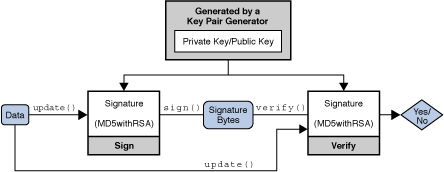
A
Signatureobject is initialized for signing with a Private Key and is given the data to be signed. The resulting signature bytes are typically kept with the signed data. When verification is needed, anotherSignatureobject is created and initialized for verification and given the corresponding Public Key. The data and the signature bytes are fed to the signature object, and if the data and signature match, theSignatureobject reports success.Even though a signature seems similar to a message digest, they have very different purposes in the type of protection they provide. In fact, algorithms such as "SHA1WithRSA" use the message digest "SHA1" to initially "compress" the large data sets into a more manageable form, then sign the resulting 20 byte message digest with the "RSA" algorithm.
Please see the Examples section for an example of signing and verifying data.
SignatureObject StatesSignatureobjects are modal objects. This means that aSignatureobject is always in a given state, where it may only do one type of operation. States are represented as final integer constants defined in their respective classes.The three states a
Signatureobject may have are:When it is first created, a
UNINITIALIZEDSIGNVERIFYSignatureobject is in theUNINITIALIZEDstate. TheSignatureclass defines two initialization methods,initSignandinitVerify, which change the state toSIGNandVERIFY, respectively.Creating a
SignatureObjectThe first step for signing or verifying a signature is to create aSignatureinstance.Signatureobjects are obtained by using one of theSignaturegetInstance()static factory methods.Initializing a
SignatureObjectA
Signatureobject must be initialized before it is used. The initialization method depends on whether the object is going to be used for signing or for verification.If it is going to be used for signing, the object must first be initialized with the private key of the entity whose signature is going to be generated. This initialization is done by calling the method:
This method puts thefinal void initSign(PrivateKey privateKey)Signatureobject in theSIGNstate.If instead the
Signatureobject is going to be used for verification, it must first be initialized with the public key of the entity whose signature is going to be verified. This initialization is done by calling either of these methods:
    final void initVerify(PublicKey publicKey)

    final void initVerify(Certificate certificate)
This method puts the
Signatureobject in theVERIFYstate.Signing
If the
Signatureobject has been initialized for signing (if it is in theSIGNstate), the data to be signed can then be supplied to the object. This is done by making one or more calls to one of theupdatemethods:
final void update(byte b)
final void update(byte[] data)
final void update(byte[] data, int off, int len)
Calls to the
updatemethod(s) should be made until all the data to be signed has been supplied to theSignatureobject.To generate the signature, simply call one of the
signmethods:final byte[] sign() final int sign(byte[] outbuf, int offset, int len)The first method returns the signature result in a byte array. The second stores the signature result in the provided buffer outbuf, starting at offset. len is the number of bytes in outbuf allotted for the signature. The method returns the number of bytes actually stored.
Signature encoding is algorithm specific. See the Standard Names document for more information about the use of ASN.1 encoding in the Java Cryptography Architecture.
A call to a
signmethod resets the signature object to the state it was in when previously initialized for signing via a call toinitSign. That is, the object is reset and available to generate another signature with the same private key, if desired, via new calls toupdateandsign.Alternatively, a new call can be made to
initSignspecifying a different private key, or toinitVerify(to initialize theSignatureobject to verify a signature).Verifying
If the
Signatureobject has been initialized for verification (if it is in theVERIFYstate), it can then verify if an alleged signature is in fact the authentic signature of the data associated with it. To start the process, the data to be verified (as opposed to the signature itself) is supplied to the object. The data is passed to the object by calling one of theupdatemethods:final void update(byte b) final void update(byte[] data) final void update(byte[] data, int off, int len)Calls to the
updatemethod(s) should be made until all the data to be verified has been supplied to theSignatureobject. The signature can now be verified by calling one of theverifymethods:final boolean verify(byte[] signature) final boolean verify(byte[] signature, int offset, int length)The argument must be a byte array containing the signature. The argument must be a byte array containing the signature. This byte array would hold the signature bytes which were returned by a previous call to one of the
signmethods.The
verifymethod returns abooleanindicating whether or not the encoded signature is the authentic signature of the data supplied to theupdatemethod(s).A call to the
verifymethod resets the signature object to its state when it was initialized for verification via a call toinitVerify. That is, the object is reset and available to verify another signature from the identity whose public key was specified in the call toinitVerify.Alternatively, a new call can be made to
initVerifyspecifying a different public key (to initialize theSignatureobject for verifying a signature from a different entity), or toinitSign(to initialize theSignatureobject for generating a signature).The Cipher Class
The
Cipherclass provides the functionality of a cryptographic cipher used for encryption and decryption. Encryption is the process of taking data (called cleartext) and a key, and producing data (ciphertext) meaningless to a third-party who does not know the key. Decryption is the inverse process: that of taking ciphertext and a key and producing cleartext.
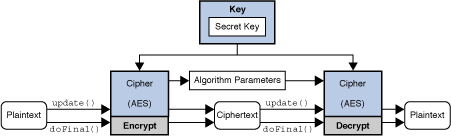
Symmetric vs. Asymmetric Cryptography
There are two major types of encryption: symmetric (also known as secret key), and asymmetric (or public key cryptography). In symmetric cryptography, the same secret key to both encrypt and decrypt the data. Keeping the key private is critical to keeping the data confidential. On the other hand, asymmetric cryptography uses a public/private key pair to encrypt data. Data encrypted with one key is decrypted with the other. A user first generates a public/private key pair, and then publishes the public key in a trusted database that anyone can access. A user who wishes to communicate securely with that user encrypts the data using the retrieved public key. Only the holder of the private key will be able to decrypt. Keeping the private key confidential is critical to this scheme.Asymmetric algorithms (such as RSA) are generally much slower than symmetric ones. These algorithms are not designed for efficiently protecting large amounts of data. In practice, asymmetric algorithms are used to exchange smaller secret keys which are used to initialize symmetric algorithms.
Stream vs. Block Ciphers
There are two major types of ciphers: block and stream. Block ciphers process entire blocks at a time, usually many bytes in length. If there is not enough data to make a complete input block, the data must be padded: that is, before encryption, dummy bytes must be added to make a multiple of the cipher's block size. These bytes are then stripped off during the decryption phase. The padding can either be done by the application, or by initializing a cipher to use a padding type such as "PKCS5PADDING". In contrast, stream ciphers process incoming data one small unit (typically a byte or even a bit) at a time. This allows for ciphers to process an arbitrary amount of data without padding.Modes Of Operation
When encrypting using a simple block cipher, two identical blocks of plaintext will always produce an identical block of cipher text. Cryptanalysts trying to break the ciphertext will have an easier job if they note blocks of repeating text. In order to add more complexity to the text, feedback modes use the previous block of output to alter the input blocks before applying the encryption algorithm. The first block will need an initial value, and this value is called the initialization vector (IV). Since the IV simply alters the data before any encryption, the IV should be random but does not necessarily need to be kept secret. There are a variety of modes, such as CBC (Cipher Block Chaining), CFB (Cipher Feedback Mode), and OFB (Output Feedback Mode). ECB (Electronic Cookbook Mode) is a mode with no feedback.Some algorithms such as AES and RSA allow for keys of different lengths, but others are fixed, such as DES and 3DES. Encryption using a longer key generally implies a stronger resistance to message recovery. As usual, there is a trade off between security and time, so choose the key length appropriately.
Most algorithms use binary keys. Most humans do not have the ability to remember long sequences of binary numbers, even when represented in hexadecimal. Character passwords are much easier to recall. Because character passwords are generally chosen from a small number of characters (for example, [a-zA-Z0-9]), protocols such as "Password-Based Encryption" (PBE) have been defined which take character passwords and generate strong binary keys. In order to make the task of getting from password to key very time-consuming for an attacker (via so-called "dictionary attacks" where common dictionary word->value mappings are precomputed), most PBE implementations will mix in a random number, known as a salt, to increase the key randomness.
Creating a Cipher Object
Cipherobjects are obtained by using one of theCiphergetInstance()static factory methods. Here, the algorithm name is slightly different than with other engine classes, in that it specifies not just an algorithm name, but a "transformation". A transformation is a string that describes the operation (or set of operations) to be performed on the given input to produce some output. A transformation always includes the name of a cryptographic algorithm (e.g.,DES), and may be followed by a mode and padding scheme.A transformation is of the form:
- "algorithm/mode/padding" or
- "algorithm"
For example, the following are valid transformations:
    "DES/CBC/PKCS5Padding"

    "DES"
If just a transformation name is specified, the system will determine if there is an implementation of the requested transformation available in the environment, and if there is more than one, returns there is a preferred one.
If both a transformation name and a package provider are specified, the system will determine if there is an implementation of the requested transformation in the package requested, and throw an exception if there is not.
If no mode or padding is specified, provider-specific default values for the mode and padding scheme are used. For example, the
SunJCEprovider usesECBas the default mode, andPKCS5Paddingas the default padding scheme forDES,DES-EDEandBlowfishciphers. This means that in the case of theSunJCEprovider:
Cipher c1 = Cipher.getInstance("DES/ECB/PKCS5Padding");andCipher c1 = Cipher.getInstance("DES");are equivalent statements.Using modes such as CFB and OFB, block ciphers can encrypt data in units smaller than the cipher's actual block size. When requesting such a mode, you may optionally specify the number of bits to be processed at a time by appending this number to the mode name as shown in the "DES/CFB8/NoPadding" and "DES/OFB32/PKCS5Padding" transformations. If no such number is specified, a provider-specific default is used. (For example, the
SunJCEprovider uses a default of 64 bits for DES.) Thus, block ciphers can be turned into byte-oriented stream ciphers by using an 8 bit mode such as CFB8 or OFB8.Appendix A of this document contains a list of standard names that can be used to specify the algorithm name, mode, and padding scheme components of a transformation.
The objects returned by factory methods are uninitialized, and must be initialized before they become usable.
Initializing a Cipher Object
A Cipher object obtained via
getInstancemust be initialized for one of four modes, which are defined as final integer constants in theCipherclass. The modes can be referenced by their symbolic names, which are shown below along with a description of the purpose of each mode:
- ENCRYPT_MODE
- Encryption of data.
- DECRYPT_MODE
- Decryption of data.
- WRAP_MODE
- Wrapping a
java.security.Keyinto bytes so that the key can be securely transported.- UNWRAP_MODE
- Unwrapping of a previously wrapped key into a
java.security.Keyobject.Each of the Cipher initialization methods takes an operational mode parameter (
opmode), and initializes the Cipher object for that mode. Other parameters include the key (key) or certificate containing the key (certificate), algorithm parameters (params), and a source of randomness (random).To initialize a Cipher object, call one of the following
initmethods:public void init(int opmode, Key key); public void init(int opmode, Certificate certificate); public void init(int opmode, Key key, SecureRandom random); public void init(int opmode, Certificate certificate, SecureRandom random); public void init(int opmode, Key key, AlgorithmParameterSpec params); public void init(int opmode, Key key, AlgorithmParameterSpec params, SecureRandom random); public void init(int opmode, Key key, AlgorithmParameters params); public void init(int opmode, Key key, AlgorithmParameters params, SecureRandom random);If a Cipher object that requires parameters (e.g., an initialization vector) is initialized for encryption, and no parameters are supplied to the
initmethod, the underlying cipher implementation is supposed to supply the required parameters itself, either by generating random parameters or by using a default, provider-specific set of parameters.However, if a Cipher object that requires parameters is initialized for decryption, and no parameters are supplied to the
initmethod, anInvalidKeyExceptionorInvalidAlgorithmParameterExceptionexception will be raised, depending on theinitmethod that has been used.See the section about Managing Algorithm Parameters for more details.
The same parameters that were used for encryption must be used for decryption.
Note that when a Cipher object is initialized, it loses all previously-acquired state. In other words, initializing a Cipher is equivalent to creating a new instance of that Cipher, and initializing it. For example, if a Cipher is first initialized for decryption with a given key, and then initialized for encryption, it will lose any state acquired while in decryption mode.
Encrypting and Decrypting Data
Data can be encrypted or decrypted in one step (single-part operation) or in multiple steps (multiple-part operation). A multiple-part operation is useful if you do not know in advance how long the data is going to be, or if the data is too long to be stored in memory all at once.
To encrypt or decrypt data in a single step, call one of the
doFinalmethods:public byte[] doFinal(byte[] input); public byte[] doFinal(byte[] input, int inputOffset, int inputLen); public int doFinal(byte[] input, int inputOffset, int inputLen, byte[] output); public int doFinal(byte[] input, int inputOffset, int inputLen, byte[] output, int outputOffset)To encrypt or decrypt data in multiple steps, call one of the
updatemethods:public byte[] update(byte[] input); public byte[] update(byte[] input, int inputOffset, int inputLen); public int update(byte[] input, int inputOffset, int inputLen, byte[] output); public int update(byte[] input, int inputOffset, int inputLen, byte[] output, int outputOffset)A multiple-part operation must be terminated by one of the above
doFinalmethods (if there is still some input data left for the last step), or by one of the followingdoFinalmethods (if there is no input data left for the last step):public byte[] doFinal(); public int doFinal(byte[] output, int outputOffset);All the
doFinalmethods take care of any necessary padding (or unpadding), if padding (or unpadding) has been requested as part of the specified transformation.A call to
doFinalresets the Cipher object to the state it was in when initialized via a call toinit. That is, the Cipher object is reset and available to encrypt or decrypt (depending on the operation mode that was specified in the call toinit) more data.Wrapping and Unwrapping Keys
Wrapping a key enables secure transfer of the key from one place to another.
The
wrap/unwrapAPI makes it more convenient to write code since it works with key objects directly. These methods also enable the possibility of secure transfer of hardware-based keys.To wrap a Key, first initialize the Cipher object for WRAP_MODE, and then call the following:
public final byte[] wrap(Key key);If you are supplying the wrapped key bytes (the result of calling
wrap) to someone else who will unwrap them, be sure to also send additional information the recipient will need in order to do theunwrap:
- the name of the key algorithm, and
- the type of the wrapped key (one of
Cipher.SECRET_KEY,Cipher.PRIVATE_KEY, orCipher.PUBLIC_KEY).The key algorithm name can be determined by calling the
getAlgorithmmethod from the Key interface:public String getAlgorithm();To unwrap the bytes returned by a previous call to
wrap, first initialize a Cipher object for UNWRAP_MODE, then call the following:public final Key unwrap(byte[] wrappedKey, String wrappedKeyAlgorithm, int wrappedKeyType));Here,
wrappedKeyis the bytes returned from the previous call to wrap,wrappedKeyAlgorithmis the algorithm associated with the wrapped key, andwrappedKeyTypeis the type of the wrapped key. This must be one ofCipher.SECRET_KEY,Cipher.PRIVATE_KEY, orCipher.PUBLIC_KEY.Managing Algorithm Parameters
The parameters being used by the underlying Cipher implementation, which were either explicitly passed to the
initmethod by the application or generated by the underlying implementation itself, can be retrieved from the Cipher object by calling itsgetParametersmethod, which returns the parameters as ajava.security.AlgorithmParametersobject (ornullif no parameters are being used). If the parameter is an initialization vector (IV), it can also be retrieved by calling thegetIVmethod.In the following example, a Cipher object implementing password-based encryption (PBE) is initialized with just a key and no parameters. However, the selected algorithm for password-based encryption requires two parameters - a salt and an iteration count. Those will be generated by the underlying algorithm implementation itself. The application can retrieve the generated parameters from the Cipher object as follows:
    import javax.crypto.*;
    import java.security.AlgorithmParameters;

    // get cipher object for password-based encryption
    Cipher c = Cipher.getInstance("PBEWithMD5AndDES");

    // initialize cipher for encryption, without supplying
    // any parameters. Here, "myKey" is assumed to refer
    // to an already-generated key.
    c.init(Cipher.ENCRYPT_MODE, myKey);

    // encrypt some data and store away ciphertext
    // for later decryption
    byte[] cipherText = c.doFinal("This is just an example".getBytes());

    // retrieve parameters generated by underlying cipher
    // implementation
    AlgorithmParameters algParams = c.getParameters();

    // get parameter encoding and store it away
    byte[] encodedAlgParams = algParams.getEncoded();
The same parameters that were used for encryption must be used for decryption. They can be instantiated from their encoding and used to initialize the corresponding Cipher object for decryption, as follows:
    import javax.crypto.*;
    import java.security.AlgorithmParameters;

    // get parameter object for password-based encryption
    AlgorithmParameters algParams;
    algParams = AlgorithmParameters.getInstance("PBEWithMD5AndDES");

    // initialize with parameter encoding from above
    algParams.init(encodedAlgParams);

    // get cipher object for password-based encryption
    Cipher c = Cipher.getInstance("PBEWithMD5AndDES");

    // initialize cipher for decryption, using one of the
    // init() methods that takes an AlgorithmParameters
    // object, and pass it the algParams object from above
    c.init(Cipher.DECRYPT_MODE, myKey, algParams);
If you did not specify any parameters when you initialized a Cipher object, and you are not sure whether or not the underlying implementation uses any parameters, you can find out by simply calling the
getParametersmethod of your Cipher object and checking the value returned. A return value ofnullindicates that no parameters were used.The following cipher algorithms implemented by the
SunJCEprovider use parameters:
- DES, DES-EDE, and Blowfish, when used in feedback (i.e., CBC, CFB, OFB, or PCBC) mode, use an initialization vector (IV). The
javax.crypto.spec.IvParameterSpecclass can be used to initialize a Cipher object with a given IV.- PBEWithMD5AndDES uses a set of parameters, comprising a salt and an iteration count. The
javax.crypto.spec.PBEParameterSpecclass can be used to initialize a Cipher object implementing PBEWithMD5AndDES with a given salt and iteration count.Note that you do not have to worry about storing or transferring any algorithm parameters for use by the decryption operation if you use the
SealedObjectclass. This class attaches the parameters used for sealing (encryption) to the encrypted object contents, and uses the same parameters for unsealing (decryption).Cipher Output Considerations
Some of the
updateanddoFinalmethods of Cipher allow the caller to specify the output buffer into which to encrypt or decrypt the data. In these cases, it is important to pass a buffer that is large enough to hold the result of the encryption or decryption operation.The following method in Cipher can be used to determine how big the output buffer should be:
public int getOutputSize(int inputLen)Other
Cipher-based ClassesThere are some helper classes which interally useCiphers to provide easy access to common cipher uses.The Cipher Stream Classes
A simple, secure, stream-based communication object can be created by combining existing
InputStream/OutputStreams withCipherobjects.The CipherInputStream Class
This class is a
FilterInputStreamthat encrypts or decrypts the data passing through it. It is composed of anInputStream, or one of its subclasses, and aCipher. CipherInputStream represents a secure input stream into which a Cipher object has been interposed. Thereadmethods of CipherInputStream return data that are read from the underlying InputStream but have additionally been processed by the embedded Cipher object. The Cipher object must be fully initialized before being used by a CipherInputStream.For example, if the embedded Cipher has been initialized for decryption, the CipherInputStream will attempt to decrypt the data it reads from the underlying InputStream before returning them to the application.
This class adheres strictly to the semantics, especially the failure semantics, of its ancestor classes
java.io.FilterInputStreamandjava.io.InputStream. This class has exactly those methods specified in its ancestor classes, and overrides them all, so that the data are additionally processed by the embedded cipher. Moreover, this class catches all exceptions that are not thrown by its ancestor classes. In particular, theskip(long)method skips only data that has been processed by the Cipher.It is crucial for a programmer using this class not to use methods that are not defined or overridden in this class (such as a new method or constructor that is later added to one of the super classes), because the design and implementation of those methods are unlikely to have considered security impact with regard to CipherInputStream.
As an example of its usage, suppose
cipher1has been initialized for encryption. The code below demonstrates how to use a CipherInputStream containing that cipher and a FileInputStream in order to encrypt input stream data:FileInputStream fis; FileOutputStream fos; CipherInputStream cis; fis = new FileInputStream("/tmp/a.txt"); cis = new CipherInputStream(fis, cipher1); fos = new FileOutputStream("/tmp/b.txt"); byte[] b = new byte[8]; int i = cis.read(b); while (i != -1) { fos.write(b, 0, i); i = cis.read(b); } fos.close();The above program reads and encrypts the content from the file
/tmp/a.txtand then stores the result (the encrypted bytes) in/tmp/b.txt.The following example demonstrates how to easily connect several instances of CipherInputStream and FileInputStream. In this example, assume that
cipher1andcipher2have been initialized for encryption and decryption (with corresponding keys), respectively.FileInputStream fis; FileOutputStream fos; CipherInputStream cis1, cis2; fis = new FileInputStream("/tmp/a.txt"); cis1 = new CipherInputStream(fis, cipher1); cis2 = new CipherInputStream(cis1, cipher2); fos = new FileOutputStream("/tmp/b.txt"); byte[] b = new byte[8]; int i = cis2.read(b); while (i != -1) { fos.write(b, 0, i); i = cis2.read(b); } fos.close();The above program copies the content from file
/tmp/a.txtto/tmp/b.txt, except that the content is first encrypted and then decrypted back when it is read from/tmp/a.txt. Of course since this program simply encrypts text and decrypts it back right away, it's actually not very useful except as a simple way of illustrating chaining of CipherInputStreams.Note that the read methods of the
CipherInputStreamwill block until data is returned from the underlying cipher. If a block cipher is used, a full block of cipher text will have to be obtained from the underlying InputStream.The CipherOutputStream Class
This class is a
FilterOutputStreamthat encrypts or decrypts the data passing through it. It is composed of anOutputStream, or one of its subclasses, and aCipher. CipherOutputStream represents a secure output stream into which a Cipher object has been interposed. Thewritemethods of CipherOutputStream first process the data with the embedded Cipher object before writing them out to the underlying OutputStream. The Cipher object must be fully initialized before being used by a CipherOutputStream.For example, if the embedded Cipher has been initialized for encryption, the CipherOutputStream will encrypt its data, before writing them out to the underlying output stream.
This class adheres strictly to the semantics, especially the failure semantics, of its ancestor classes
java.io.OutputStreamandjava.io.FilterOutputStream. This class has exactly those methods specified in its ancestor classes, and overrides them all, so that all data are additionally processed by the embedded cipher. Moreover, this class catches all exceptions that are not thrown by its ancestor classes.It is crucial for a programmer using this class not to use methods that are not defined or overridden in this class (such as a new method or constructor that is later added to one of the super classes), because the design and implementation of those methods are unlikely to have considered security impact with regard to CipherOutputStream.
As an example of its usage, suppose
cipher1has been initialized for encryption. The code below demonstrates how to use a CipherOutputStream containing that cipher and a FileOutputStream in order to encrypt data to be written to an output stream:FileInputStream fis; FileOutputStream fos; CipherOutputStream cos; fis = new FileInputStream("/tmp/a.txt"); fos = new FileOutputStream("/tmp/b.txt"); cos = new CipherOutputStream(fos, cipher1); byte[] b = new byte[8]; int i = fis.read(b); while (i != -1) { cos.write(b, 0, i); i = fis.read(b); } cos.flush();The above program reads the content from the file
/tmp/a.txt, then encrypts and stores the result (the encrypted bytes) in/tmp/b.txt.The following example demonstrates how to easily connect several instances of CipherOutputStream and FileOutputStream. In this example, assume that
cipher1andcipher2have been initialized for decryption and encryption (with corresponding keys), respectively:FileInputStream fis; FileOutputStream fos; CipherOutputStream cos1, cos2; fis = new FileInputStream("/tmp/a.txt"); fos = new FileOutputStream("/tmp/b.txt"); cos1 = new CipherOutputStream(fos, cipher1); cos2 = new CipherOutputStream(cos1, cipher2); byte[] b = new byte[8]; int i = fis.read(b); while (i != -1) { cos2.write(b, 0, i); i = fis.read(b); } cos2.flush();The above program copies the content from file
/tmp/a.txtto/tmp/b.txt, except that the content is first encrypted and then decrypted back before it is written to/tmp/b.txt.One thing to keep in mind when using block cipher algorithms is that a full block of plaintext data must be given to the
CipherOutputStreambefore the data will be encrypted and sent to the underlying output stream.There is one other important difference between the
flushandclosemethods of this class, which becomes even more relevant if the encapsulated Cipher object implements a block cipher algorithm with padding turned on:
flushflushes the underlying OutputStream by forcing any buffered output bytes that have already been processed by the encapsulated Cipher object to be written out. Any bytes buffered by the encapsulated Cipher object and waiting to be processed by it will not be written out.closecloses the underlying OutputStream and releases any system resources associated with it. It invokes thedoFinalmethod of the encapsulated Cipher object, causing any bytes buffered by it to be processed and written out to the underlying stream by calling itsflushmethod.The SealedObject Class
This class enables a programmer to create an object and protect its confidentiality with a cryptographic algorithm.
Given any object that implements the
java.io.Serializableinterface, one can create aSealedObjectthat encapsulates the original object, in serialized format (i.e., a "deep copy"), and seals (encrypts) its serialized contents, using a cryptographic algorithm such as DES, to protect its confidentiality. The encrypted content can later be decrypted (with the corresponding algorithm using the correct decryption key) and de-serialized, yielding the original object.A typical usage is illustrated in the following code segment: In order to seal an object, you create a
SealedObjectfrom the object to be sealed and a fully initializedCipherobject that will encrypt the serialized object contents. In this example, the String "This is a secret" is sealed using the DES algorithm. Note that any algorithm parameters that may be used in the sealing operation are stored inside ofSealedObject:// create Cipher object // NOTE: sKey is assumed to refer to an already-generated // secret DES key. Cipher c = Cipher.getInstance("DES"); c.init(Cipher.ENCRYPT_MODE, sKey); // do the sealing SealedObject so = new SealedObject("This is a secret", c);The original object that was sealed can be recovered in two different ways:
- by using a
Cipherobject that has been initialized with the exact same algorithm, key, padding scheme, etc., that were used to seal the object:c.init(Cipher.DECRYPT_MODE, sKey); try { String s = (String)so.getObject(c); } catch (Exception e) { // do something };This approach has the advantage that the party who unseals the sealed object does not require knowledge of the decryption key. For example, after one party has initialized the cipher object with the required decryption key, it could hand over the cipher object to another party who then unseals the sealed object.
- by using the appropriate decryption key (since DES is a symmetric encryption algorithm, we use the same key for sealing and unsealing):
    try {
	String s = (String)so.getObject(sKey);
    } catch (Exception e) {
	// do something
    };
In this approach, the
getObjectmethod creates a cipher object for the appropriate decryption algorithm and initializes it with the given decryption key and the algorithm parameters (if any) that were stored in the sealed object. This approach has the advantage that the party who unseals the object does not need to keep track of the parameters (e.g., the IV) that were used to seal the object.The Mac Class
Similar to a
MessageDigest, a Message Authentication Code (MAC) provides a way to check the integrity of information transmitted over or stored in an unreliable medium, but includes a secret key in the calculation. Only someone with the proper key will be able to verify the received message. Typically, message authentication codes are used between two parties that share a secret key in order to validate information transmitted between these parties.
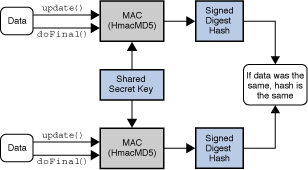
A MAC mechanism that is based on cryptographic hash functions is referred to as HMAC. HMAC can be used with any cryptographic hash function, e.g., MD5 or SHA-1, in combination with a secret shared key.
The
Macclass provides the functionality of a Message Authentication Code (MAC). Please refer to the code example.Creating a
MacObjectMacobjects are obtained by using one of theMacgetInstance()static factory methods.Initializing a Mac Object
A Mac object is always initialized with a (secret) key and may optionally be initialized with a set of parameters, depending on the underlying MAC algorithm.
To initialize a Mac object, call one of its
initmethods:public void init(Key key); public void init(Key key, AlgorithmParameterSpec params);You can initialize your Mac object with any (secret-)key object that implements the
javax.crypto.SecretKeyinterface. This could be an object returned byjavax.crypto.KeyGenerator.generateKey(), or one that is the result of a key agreement protocol, as returned byjavax.crypto.KeyAgreement.generateSecret(), or an instance ofjavax.crypto.spec.SecretKeySpec.With some MAC algorithms, the (secret-)key algorithm associated with the (secret-)key object used to initialize the Mac object does not matter (this is the case with the HMAC-MD5 and HMAC-SHA1 implementations of the
SunJCEprovider). With others, however, the (secret-)key algorithm does matter, and anInvalidKeyExceptionis thrown if a (secret-)key object with an inappropriate (secret-)key algorithm is used.Computing a MAC
A MAC can be computed in one step (single-part operation) or in multiple steps (multiple-part operation). A multiple-part operation is useful if you do not know in advance how long the data is going to be, or if the data is too long to be stored in memory all at once.
To compute the MAC of some data in a single step, call the following
doFinalmethod:public byte[] doFinal(byte[] input);To compute the MAC of some data in multiple steps, call one of the
updatemethods:public void update(byte input); public void update(byte[] input); public void update(byte[] input, int inputOffset, int inputLen);A multiple-part operation must be terminated by the above
doFinalmethod (if there is still some input data left for the last step), or by one of the followingdoFinalmethods (if there is no input data left for the last step):public byte[] doFinal(); public void doFinal(byte[] output, int outOffset);
KeyInterfacesTo this point, we have focused the high-level uses of the JCA without getting lost in the details of what keys are and how they are generated/represented. It is now time to turn our attention to keys.
The
java.security.Keyinterface is the top-level interface for all opaque keys. It defines the functionality shared by all opaque key objects.An opaque key representation is one in which you have no direct access to the key material that constitutes a key. In other words: "opaque" gives you limited access to the key--just the three methods defined by the
Keyinterface (see below):getAlgorithm,getFormat, andgetEncoded.This is in contrast to a transparent representation, in which you can access each key material value individually, through one of the
getmethods defined in the corresponding specification class.All opaque keys have three characteristics:
Keys are generally obtained through key generators such as KeyGenerator and KeyPairGenerator, certificates, key specifications (using a
- An Algorithm
- The key algorithm for that key. The key algorithm is usually an encryption or asymmetric operation algorithm (such as
AES,DSAorRSA), which will work with those algorithms and with related algorithms (such asMD5withRSA,SHA1withRSA, etc.) The name of the algorithm of a key is obtained using this method:String getAlgorithm()- An Encoded Form
- The external encoded form for the key used when a standard representation of the key is needed outside the Java Virtual Machine, as when transmitting the key to some other party. The key is encoded according to a standard format (such as X.509 or PKCS8), and is returned using the method:
byte[] getEncoded()- A Format
- The name of the format of the encoded key. It is returned by the method:
String getFormat()KeyFactory), or aKeyStoreimplementation accessing a keystore database used to manage keys. It is possible to parse encoded keys, in an algorithm-dependent manner, using aKeyFactory.It is also possible to parse certificates, using a
CertificateFactory.Here is a list of interfaces which extend the
Keyinterface in thejava.security.interfacesandjavax.crypto.interfacespackages:
The
PublicKeyandPrivateKeyInterfacesThe
PublicKeyandPrivateKeyinterfaces (which both extend theKeyinterface) are methodless interfaces, used for type-safety and type-identification.The
KeyPairClassThe
KeyPairclass is a simple holder for a key pair (a public key and a private key). It has two public methods, one for returning the private key, and the other for returning the public key:PrivateKey getPrivate() PublicKey getPublic()Key Specification Interfaces and Classes
Keyobjects and key specifications (KeySpecs) are two different representations of key data.Ciphers useKeyobjects to initialize their encryption algorithms, but keys may need to be converted into a more portable format for transmission or storage.A transparent representation of keys means that you can access each key material value individually, through one of the
getmethods defined in the corresponding specification class. For example,DSAPrivateKeySpecdefinesgetX,getP,getQ, andgetGmethods, to access the private keyx, and the DSA algorithm parameters used to calculate the key: the primep, the sub-primeq, and the baseg. If the key is stored on a hardware device, its specification may contain information that helps identify the key on the device.This representation is contrasted with an opaque representation, as defined by the
Keyinterface, in which you have no direct access to the key material fields. In other words, an "opaque" representation gives you limited access to the key--just the three methods defined by theKeyinterface:getAlgorithm,getFormat, andgetEncoded.A key may be specified in an algorithm-specific way, or in an algorithm-independent encoding format (such as ASN.1). For example, a DSA private key may be specified by its components
x,p,q, andg(seeDSAPrivateKeySpec), or it may be specified using its DER encoding (seePKCS8EncodedKeySpec).The
KeyFactoryandSecretKeyFactoryclasses can be used to convert between opaque and transparent key representations (that is, betweenKeys andKeySpecs, assuming that the operation is possible. (For example, private keys on smart cards might not be able leave the card. SuchKeys are not convertible.)In the following sections, we discuss the key specification interfaces and classes in the
java.security.specpackage.The
KeySpecInterfaceThis interface contains no methods or constants. Its only purpose is to group and provide type safety for all key specifications. All key specifications must implement this interface.
The
KeySpecSubinterfacesLike theKeyinterface, there are a similar set ofKeySpecinterfaces.
The
EncodedKeySpecClassThis abstract class (which implements theKeySpecinterface) represents a public or private key in encoded format. ItsgetEncodedmethod returns the encoded key:and itsabstract byte[] getEncoded();getFormatmethod returns the name of the encoding format:abstract String getFormat();See the next sections for the concrete implementations
PKCS8EncodedKeySpecandX509EncodedKeySpec.The
PKCS8EncodedKeySpecClassThis class, which is a subclass ofEncodedKeySpec, represents the DER encoding of a private key, according to the format specified in the PKCS8 standard. ItsgetEncodedmethod returns the key bytes, encoded according to the PKCS8 standard. ItsgetFormatmethod returns the string "PKCS#8".The
X509EncodedKeySpecClassThis class, which is a subclass ofEncodedKeySpec, represents the DER encoding of a public key, according to the format specified in the X.509 standard. ItsgetEncodedmethod returns the key bytes, encoded according to the X.509 standard. ItsgetFormatmethod returns the string "X.509".Of Generators and Factories
Newcomers to Java and the JCA APIs in particular sometimes do not grasp the distinction between generators and factories.
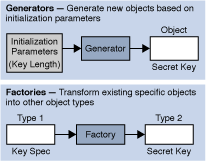
Generators are used to generate brand new objects. Generators can be initialized in either an algorithm-dependent or algorithm-independent way. For example, to create a Diffie-Hellman (DH) keypair, an application could specify the necessary P and G values, or the the generator could simply be initialized with the appropriate key length, and the generator will select appropriate P and G values. In both cases, the generator will produce brand new keys based on the parameters.
On the other hand, factories are used to convert data from one existing object type to another. For example, an application might have available the components of a DH private key and can package them as a
KeySpec, but needs to convert them into aPrivateKeyobject that can be used by aKeyAgreementobject, or vice-versa. Or they might have the byte array of a certificate, but need to use aCertificateFactoryto convert it into aX509Certificateobject. Applications use factory objects to do the conversion.The
KeyFactoryClassTheKeyFactoryclass is an engine class designed to perform conversions between opaque cryptographicKeys and key specifications (transparent representations of the underlying key material).
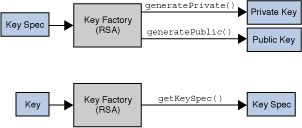
Key factories are bi-directional. They allow you to build an opaque key object from a given key specification (key material), or to retrieve the underlying key material of a key object in a suitable format.
Multiple compatible key specifications can exist for the same key. For example, a DSA public key may be specified by its components
y,p,q, andg(seejava.security.spec.DSAPublicKeySpec), or it may be specified using its DER encoding according to the X.509 standard (seeX509EncodedKeySpec).A key factory can be used to translate between compatible key specifications. Key parsing can be achieved through translation between compatible key specifications, e.g., when you translate from
X509EncodedKeySpectoDSAPublicKeySpec, you basically parse the encoded key into its components. For an example, see the end of the Generating/Verifying Signatures Using Key Specifications andKeyFactorysection.Creating a
KeyFactoryObject
KeyFactoryobjects are obtained by using one of theKeyFactorygetInstance()static factory methods.Converting Between a Key Specification and a Key Object
If you have a key specification for a public key, you can obtain an opaque
PublicKeyobject from the specification by using thegeneratePublicmethod:PublicKey generatePublic(KeySpec keySpec)Similarly, if you have a key specification for a private key, you can obtain an opaque
PrivateKeyobject from the specification by using thegeneratePrivatemethod:PrivateKey generatePrivate(KeySpec keySpec)Converting Between a Key Object and a Key Specification
If you have a
Keyobject, you can get a corresponding key specification object by calling thegetKeySpecmethod:KeySpec getKeySpec(Key key, Class keySpec)keySpecidentifies the specification class in which the key material should be returned. It could, for example, beDSAPublicKeySpec.class, to indicate that the key material should be returned in an instance of theDSAPublicKeySpecclass.Please see the Examples section for more details.
The SecretKeyFactory Class
This class represents a factory for secret keys. Unlike
KeyFactory, ajavax.crypto.SecretKeyFactoryobject operates only on secret (symmetric) keys, whereas ajava.security.KeyFactoryobject processes the public and private key components of a key pair.
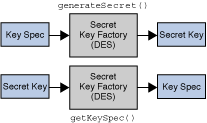
Key factories are used to convert
Keys (opaque cryptographic keys of typejava.security.Key) into key specifications (transparent representations of the underlying key material in a suitable format), and vice versa.Objects of type
java.security.Key, of whichjava.security.PublicKey,java.security.PrivateKey, andjavax.crypto.SecretKeyare subclasses, are opaque key objects, because you cannot tell how they are implemented. The underlying implementation is provider-dependent, and may be software or hardware based. Key factories allow providers to supply their own implementations of cryptographic keys.For example, if you have a key specification for a Diffie Hellman public key, consisting of the public value
y, the prime modulusp, and the baseg, and you feed the same specification to Diffie-Hellman key factories from different providers, the resultingPublicKeyobjects will most likely have different underlying implementations.A provider should document the key specifications supported by its secret key factory. For example, the
SecretKeyFactoryfor DES keys supplied by theSunJCEprovider supportsDESKeySpecas a transparent representation of DES keys, theSecretKeyFactoryfor DES-EDE keys supportsDESedeKeySpecas a transparent representation of DES-EDE keys, and theSecretKeyFactoryfor PBE supportsPBEKeySpecas a transparent representation of the underlying password.The following is an example of how to use a
SecretKeyFactoryto convert secret key data into aSecretKeyobject, which can be used for a subsequentCipheroperation:// Note the following bytes are not realistic secret key data // bytes but are simply supplied as an illustration of using data // bytes (key material) you already have to build a DESKeySpec. byte[] desKeyData = { (byte)0x01, (byte)0x02, (byte)0x03, (byte)0x04, (byte)0x05, (byte)0x06, (byte)0x07, (byte)0x08 }; DESKeySpec desKeySpec = new DESKeySpec(desKeyData); SecretKeyFactory keyFactory = SecretKeyFactory.getInstance("DES"); SecretKey secretKey = keyFactory.generateSecret(desKeySpec);In this case, the underlying implementation of
SecretKeyis based on the provider ofKeyFactory.An alternative, provider-independent way of creating a functionally equivalent
SecretKeyobject from the same key material is to use thejavax.crypto.spec.SecretKeySpecclass, which implements thejavax.crypto.SecretKeyinterface:byte[] desKeyData = { (byte)0x01, (byte)0x02, ...}; SecretKeySpec secretKey = new SecretKeySpec(desKeyData, "DES");Creating a
SecretKeyFactoryObject
SecretKeyFactoryobjects are obtained by using one of theSecretKeyFactorygetInstance()static factory methods.Converting Between a Key Specification and a Secret Key Object
If you have a key specification for a secret key, you can obtain an opaque
SecretKeyobject from the specification by using thegenerateSecretmethod:SecretKey generateSecret(KeySpec keySpec)Converting Between a Secret Key Object and a Key Specification
If you have a
Secret Keyobject, you can get a corresponding key specification object by calling thegetKeySpecmethod:KeySpec getKeySpec(Key key, Class keySpec)keySpecidentifies the specification class in which the key material should be returned. It could, for example, beDESKeySpec.class, to indicate that the key material should be returned in an instance of theDESKeySpecclass.The
KeyPairGeneratorClassThe
KeyPairGeneratorclass is an engine class used to generate pairs of public and private keys.
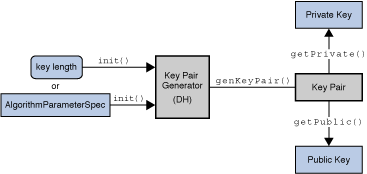
There are two ways to generate a key pair: in an algorithm-independent manner, and in an algorithm-specific manner. The only difference between the two is the initialization of the object.
Please see the Examples section for examples of calls to the methods documented below.
Creating a
KeyPairGeneratorAll key pair generation starts with a
KeyPairGenerator.KeyPairGeneratorobjects are obtained by using one of theKeyPairGeneratorgetInstance()static factory methods.Initializing a
KeyPairGeneratorA key pair generator for a particular algorithm creates a public/private key pair that can be used with this algorithm. It also associates algorithm-specific parameters with each of the generated keys.A key pair generator needs to be initialized before it can generate keys. In most cases, algorithm-independent initialization is sufficient. But in other cases, algorithm-specific initialization can be used.
Algorithm-Independent Initialization
All key pair generators share the concepts of a keysize and a source of randomness. The keysize is interpreted differently for different algorithms. For example, in the case of the DSA algorithm, the keysize corresponds to the length of the modulus. (See the Standard Names document for information about the keysizes for specific algorithms.)
An
initializemethod takes two universally shared types of arguments:Anothervoid initialize(int keysize, SecureRandom random)initializemethod takes only akeysizeargument; it uses a system-provided source of randomness:void initialize(int keysize)Since no other parameters are specified when you call the above algorithm-independent
initializemethods, it is up to the provider what to do about the algorithm-specific parameters (if any) to be associated with each of the keys.If the algorithm is a "DSA" algorithm, and the modulus size (keysize) is 512, 768, or 1024, then the
SUNprovider uses a set of precomputed values for thep,q, andgparameters. If the modulus size is not one of the above values, theSUNprovider creates a new set of parameters. Other providers might have precomputed parameter sets for more than just the three modulus sizes mentioned above. Still others might not have a list of precomputed parameters at all and instead always create new parameter sets.Algorithm-Specific Initialization
For situations where a set of algorithm-specific parameters already exists (such as "community parameters" in DSA), there are two
initializemethods that have anAlgorithmParameterSpecargument. One also has aSecureRandomargument, while the source of randomness is system-provided for the other:See the Examples section for more details.void initialize(AlgorithmParameterSpec params, SecureRandom random) void initialize(AlgorithmParameterSpec params)Generating a Key Pair
The procedure for generating a key pair is always the same, regardless of initialization (and of the algorithm). You always call the following method from
KeyPairGenerator:Multiple calls toKeyPair generateKeyPair()generateKeyPairwill yield different key pairs.The KeyGenerator Class
A key generator is used to generate secret keys for symmetric algorithms.

Creating a
KeyGeneratorKeyGeneratorobjects are obtained by using one of theKeyGeneratorgetInstance()static factory methods.Initializing a KeyGenerator Object
A key generator for a particular symmetric-key algorithm creates a symmetric key that can be used with that algorithm. It also associates algorithm-specific parameters (if any) with the generated key.
There are two ways to generate a key: in an algorithm-independent manner, and in an algorithm-specific manner. The only difference between the two is the initialization of the object:
- Algorithm-Independent Initialization
All key generators share the concepts of a keysize and a source of randomness. There is an
initmethod that takes these two universally shared types of arguments. There is also one that takes just akeysizeargument, and uses a system-provided source of randomness, and one that takes just a source of randomness:public void init(SecureRandom random); public void init(int keysize); public void init(int keysize, SecureRandom random);Since no other parameters are specified when you call the above algorithm-independent
initmethods, it is up to the provider what to do about the algorithm-specific parameters (if any) to be associated with the generated key.- Algorithm-Specific Initialization
For situations where a set of algorithm-specific parameters already exists, there are two
initmethods that have anAlgorithmParameterSpecargument. One also has aSecureRandomargument, while the source of randomness is system-provided for the other:public void init(AlgorithmParameterSpec params); public void init(AlgorithmParameterSpec params, SecureRandom random);In case the client does not explicitly initialize the KeyGenerator (via a call to an
initmethod), each provider must supply (and document) a default initialization.Creating a Key
The following method generates a secret key:public SecretKey generateKey();The KeyAgreement Class
Key agreement is a protocol by which 2 or more parties can establish the same cryptographic keys, without having to exchange any secret information.
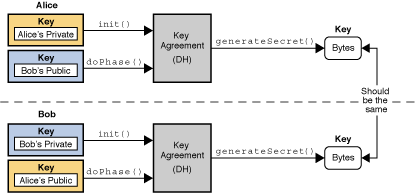
Each party initializes their key agreement object with their private key, and then enters the public keys for each party that will participate in the communication. In most cases, there are just two parties, but algorithms such as Diffie-Hellman allow for multiple parties (3 or more) to participate. When all the public keys have been entered, each
KeyAgreementobject will generate (agree upon) the same key.The KeyAgreement class provides the functionality of a key agreement protocol. The keys involved in establishing a shared secret are created by one of the key generators (
KeyPairGeneratororKeyGenerator), aKeyFactory, or as a result from an intermediate phase of the key agreement protocol.Creating a KeyAgreement Object
Each party involved in the key agreement has to create a KeyAgreement object.
KeyAgreementobjects are obtained by using one of theKeyAgreementgetInstance()static factory methods.Initializing a KeyAgreement Object
You initialize a KeyAgreement object with your private information. In the case of Diffie-Hellman, you initialize it with your Diffie-Hellman private key. Additional initialization information may contain a source of randomness and/or a set of algorithm parameters. Note that if the requested key agreement algorithm requires the specification of algorithm parameters, and only a key, but no parameters are provided to initialize the KeyAgreement object, the key must contain the required algorithm parameters. (For example, the Diffie-Hellman algorithm uses a prime modulus
pand a base generatorgas its parameters.)To initialize a KeyAgreement object, call one of its
initmethods:public void init(Key key); public void init(Key key, SecureRandom random); public void init(Key key, AlgorithmParameterSpec params); public void init(Key key, AlgorithmParameterSpec params, SecureRandom random);Executing a KeyAgreement Phase
Every key agreement protocol consists of a number of phases that need to be executed by each party involved in the key agreement.
To execute the next phase in the key agreement, call the
doPhasemethod:public Key doPhase(Key key, boolean lastPhase);The
keyparameter contains the key to be processed by that phase. In most cases, this is the public key of one of the other parties involved in the key agreement, or an intermediate key that was generated by a previous phase.doPhasemay return an intermediate key that you may have to send to the other parties of this key agreement, so they can process it in a subsequent phase.The
lastPhaseparameter specifies whether or not the phase to be executed is the last one in the key agreement: A value ofFALSEindicates that this is not the last phase of the key agreement (there are more phases to follow), and a value ofTRUEindicates that this is the last phase of the key agreement and the key agreement is completed, i.e.,generateSecretcan be called next.In the example of Diffie-Hellman between two parties , you call
doPhaseonce, withlastPhaseset toTRUE. In the example of Diffie-Hellman between three parties, you calldoPhasetwice: the first time withlastPhaseset toFALSE, the 2nd time withlastPhaseset toTRUE.Generating the Shared Secret
After each party has executed all the required key agreement phases, it can compute the shared secret by calling one of the
generateSecretmethods:public byte[] generateSecret(); public int generateSecret(byte[] sharedSecret, int offset); public SecretKey generateSecret(String algorithm);Key Management
A database called a "keystore" can be used to manage a repository of keys and certificates. (A certificate is a digitally signed statement from one entity, saying that the public key of some other entity has a particular value.)Keystore Location
The user keystore is by default stored in a file named
.keystorein the user's home directory, as determined by the "user.home" system property. On Solaris systems "user.home" defaults to the user's home directory. On Win32 systems, given user name uName, "user.home" defaults to:Of course, keystore files can be located as desired. In some environments, it may make sense for multiple keystores to exist. For example, in JSSE (SSL/TLS), one keystore might hold a user's private keys, and another might hold certificates used to establish trust relationships.
- C:\Winnt\Profiles\uName on multi-user Windows NT systems
- C:\Windows\Profiles\uName on multi-user Windows 95/98/2000 systems
- C:\Windows on single-user Windows 95/98/2000 systems
In addition to the user's keystore, the Sun JDK also maintains a system-wide keystore which is used to store trusted certificates from a variety of Certificate Authorities (CA's). These CA certificates can be used to help make trust decisions. For example, in SSL/TLS when the
SunJSSEprovider is presented with certificates from a remote peer, the default trustmanager will consult the:<java-home>/lib/ext/cacerts [Unix], or <java-home>\lib\ext\cacerts [Windows]file to determine if the connection is to be trusted. Instead of using the system-widecacertskeystore, applications can set up and use their own keystores, or even use the user keystore described above.Keystore Implementation
TheKeyStoreclass supplies well-defined interfaces to access and modify the information in a keystore. It is possible for there to be multiple different concrete implementations, where each implementation is that for a particular type of keystore.Currently, there are two command-line tools that make use of
KeyStore:keytoolandjarsigner, and also a GUI-based tool namedpolicytool. It is also used by thePolicyreference implementation when it processes policy files specifying the permissions (allowed accesses to system resources) to be granted to code from various sources. SinceKeyStoreis publicly available, JDK users can write additional security applications that use it.Applications can choose different types of keystore implementations from different providers, using the
getInstancefactory method in theKeyStoreclass. A keystore type defines the storage and data format of the keystore information, and the algorithms used to protect private keys in the keystore and the integrity of the keystore itself. Keystore implementations of different types are not compatible.There is a built-in default keystore implementation type known as "
jks" that is provided by Sun Microsystems. It implements the keystore as a file, utilizing a proprietary keystore type (format). It protects each private key with its own individual password, and also protects the integrity of the entire keystore with a (possibly different) password. The default is specified by the following line in the security properties file:keystore.type=jksTo have tools and other applications use a different default keystore implementation, you can change that line to specify a default type. If you have a provider package that supplies a keystore implementation for a keystore type called "jceks", change the line to:
keystore.type=jceksSome applications, such askeytool, also let you override the default keystore type (via the-storetypecommand-line parameter).There are two other types of keystores that come with the Sun JDK implementation.
NOTE: Keystore type designations are not case-sensitive. For example, "jks" would be considered the same as "jks".
- "jceks" is an alternate proprietary keystore format to "jks" that uses much stronger encryption in the form of Password-Based Encryption with Triple-DES.
The Sun "jceks" implementation can parse and convert a "jks" keystore file to the "jceks" format. You may upgrade your keystore of type "jks" to a keystore of type "jceks" by changing the password of a private-key entry in your keystore and specifying
"-storetype jceks"as the keystore type. To apply the cryptographically strong(er) key protection supplied to a private key named "signkey" in your default keystore, use the following command, which will prompt you for the old and new key passwords:See Security Tools for more information aboutkeytool -keypasswd -alias signkey -storetype jcekskeytooland about keystores and how they are managed.- "pkcs12" is another option. This is a cross platform keystore based on the RSA PKCS12 Personal Information Exchange Syntax Standard. This standard is primarily meant for storing or transporting a user's private keys, certificates, and miscellaneous secrets. As of JDK 6, standards for storing Trusted Certificates in "pkcs12" have not been established yet, and thus "jks" or "jceks" should be used for trusted certificates.
Keystore implementations are provider-based. Developers interested in writing their own KeyStore implementations should consult How to Implement a Provider for the Java Cryptography Architecture for more information on this topic.
The
KeyStoreClassTheKeyStoreclass is an engine class that supplies well-defined interfaces to access and modify the information in a keystore.
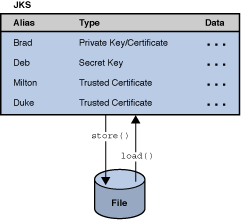
This class represents an in-memory collection of keys and certificates.
KeyStoremanages two types of entries:Each entry in a keystore is identified by an "alias" string. In the case of private keys and their associated certificate chains, these strings distinguish among the different ways in which the entity may authenticate itself. For example, the entity may authenticate itself using different certificate authorities, or using different public key algorithms.
- Key Entry
This type of keystore entry holds very sensitive cryptographic key information, which is stored in a protected format to prevent unauthorized access. Typically, a key stored in this type of entry is a secret key, or a private key accompanied by the certificate chain authenticating the corresponding public key.
Private keys and certificate chains are used by a given entity for self-authentication using digital signatures. For example, software distribution organizations digitally sign JAR files as part of releasing and/or licensing software.
- Trusted Certificate Entry
This type of entry contains a single public key certificate belonging to another party. It is called a trusted certificate because the keystore owner trusts that the public key in the certificate indeed belongs to the identity identified by the subject (owner) of the certificate.
This type of entry can be used to authenticate other parties.
Whether keystores are persistent, and the mechanisms used by the keystore if it is persistent, are not specified here. This convention allows use of a variety of techniques for protecting sensitive (e.g., private or secret) keys. Smart cards or other integrated cryptographic engines (SafeKeyper) are one option, and simpler mechanisms such as files may also be used (in a variety of formats).
The main
KeyStoremethods are described below.Creating a
KeyStoreObject
KeyStoreobjects are obtained by using one of theKeyStoregetInstance()static factory methods.Loading a Particular Keystore into Memory
Before aKeyStoreobject can be used, the actual keystore data must be loaded into memory via theloadmethod:The optional password is used to check the integrity of the keystore data. If no password is supplied, no integrity check is performed.final void load(InputStream stream, char[] password)To create an empty keystore, you pass
nullas theInputStreamargument to theloadmethod.Getting a List of the Keystore Aliases
All keystore entries are accessed via unique aliases. The
aliasesmethod returns an enumeration of the alias names in the keystore:final Enumeration aliases()Determining Keystore Entry Types
As stated in TheKeyStoreClass, there are two different types of entries in a keystore.The following methods determine whether the entry specified by the given alias is a key/certificate or a trusted certificate entry, respectively:
final boolean isKeyEntry(String alias)
final boolean isCertificateEntry(String alias)
Adding/Setting/Deleting Keystore Entries
ThesetCertificateEntrymethod assigns a certificate to a specified alias:Iffinal void setCertificateEntry(String alias, Certificate cert)aliasdoesn't exist, a trusted certificate entry with that alias is created. Ifaliasexists and identifies a trusted certificate entry, the certificate associated with it is replaced bycert.The
setKeyEntrymethods add (ifaliasdoesn't yet exist) or set key entries:In the method withfinal void setKeyEntry(String alias, Key key, char[] password, Certificate[] chain) final void setKeyEntry(String alias, byte[] key, Certificate[] chain)keyas a byte array, it is the bytes for a key in protected format. For example, in the keystore implementation supplied by theSUNprovider, thekeybyte array is expected to contain a protected private key, encoded as anEncryptedPrivateKeyInfoas defined in the PKCS8 standard. In the other method, thepasswordis the password used to protect the key.The
deleteEntrymethod deletes an entry:final void deleteEntry(String alias)Getting Information from the Keystore
ThegetKeymethod returns the key associated with the given alias. The key is recovered using the given password:The following methods return the certificate, or certificate chain, respectively, associated with the given alias:final Key getKey(String alias, char[] password)You can determine the name (final Certificate getCertificate(String alias) final Certificate[] getCertificateChain(String alias)alias) of the first entry whose certificate matches a given certificate via the following:final String getCertificateAlias(Certificate cert)Saving the KeyStore
The in-memory keystore can be saved via thestoremethod:The password is used to calculate an integrity checksum of the keystore data, which is appended to the keystore data.final void store(OutputStream stream, char[] password)Algorithm Parameters Classes
LikeKeys andKeyspecs, an algorithm's initialization parameters are represented by eitherAlgorithmParameters orAlgorithmParameterSpecs. Depending on the use situation, algorithms can use the parameters directly, or the parameters might need to be converted into a more portable format for transmission or storage.A transparent representation of a set of parameters (via
AlgorithmParameterSpec) means that you can access each parameter value in the set individually. You can access these values through one of thegetmethods defined in the corresponding specification class (e.g.,DSAParameterSpecdefinesgetP,getQ, andgetGmethods, to accessp,q, andg, respectively).In contrast, the
AlgorithmParametersclass supplies an opaque representation, in which you have no direct access to the parameter fields. You can only get the name of the algorithm associated with the parameter set (viagetAlgorithm) and some kind of encoding for the parameter set (viagetEncoded).The
AlgorithmParameterSpecInterfaceAlgorithmParameterSpecis an interface to a transparent specification of cryptographic parameters. This interface contains no methods or constants. Its only purpose is to group (and provide type safety for) all parameter specifications. All parameter specifications must implement this interface.The algorithm parameter specification interfaces and classes in the
java.security.specandjavax.crypto.specpackages are described in the JDK javadocs:
The following algorithm parameter specs are used specifically for digital signatures, as part of JSR 105.
The
AlgorithmParametersClassTheAlgorithmParametersclass is an engine class that provides an opaque representation of cryptographic parameters. You can initialize theAlgorithmParametersclass using a specificAlgorithmParameterSpecobject, or by encoding the parameters in a recognized format. You can retrieve the resulting specification with thegetParameterSpecmethod (see the following section).Creating an
AlgorithmParametersObject
AlgorithmParametersobjects are obtained by using one of theAlgorithmParametersgetInstance()static factory methods.Initializing an
AlgorithmParametersObjectOnce an
AlgorithmParametersobject is instantiated, it must be initialized via a call toinit, using an appropriate parameter specification or parameter encoding:In thesevoid init(AlgorithmParameterSpec paramSpec) void init(byte[] params) void init(byte[] params, String format)initmethods,paramsis an array containing the encoded parameters, andformatis the name of the decoding format. In theinitmethod with aparamsargument but noformatargument, the primary decoding format for parameters is used. The primary decoding format is ASN.1, if an ASN.1 specification for the parameters exists.
NOTE:AlgorithmParametersobjects can be initialized only once. They are not reusable.
Obtaining the Encoded Parameters
A byte encoding of the parameters represented in an
AlgorithmParametersobject may be obtained via a call togetEncoded:This method returns the parameters in their primary encoding format. The primary encoding format for parameters is ASN.1, if an ASN.1 specification for this type of parameters exists.byte[] getEncoded()If you want the parameters returned in a specified encoding format, use
Ifbyte[] getEncoded(String format)formatis null, the primary encoding format for parameters is used, as in the othergetEncodedmethod.
NOTE: In the defaultAlgorithmParametersimplementation, supplied by theSUNprovider, theformatargument is currently ignored.
Converting an
AlgorithmParametersObject to a Transparent SpecificationA transparent parameter specification for the algorithm parameters may be obtained from an
AlgorithmParametersobject via a call togetParameterSpec:AlgorithmParameterSpec getParameterSpec(Class paramSpec)paramSpecidentifies the specification class in which the parameters should be returned. The specification class could be, for example,DSAParameterSpec.classto indicate that the parameters should be returned in an instance of theDSAParameterSpecclass. (This class is in thejava.security.specpackage.)The
AlgorithmParameterGeneratorClassTheAlgorithmParameterGeneratorclass is an engine class used to generate a set of brand-new parameters suitable for a certain algorithm (the algorithm is specified when anAlgorithmParameterGeneratorinstance is created). This object is used when you do not have an existing set of algorithm parameters, and want to generate one from scratch.Creating an
AlgorithmParameterGeneratorObject
AlgorithmParameterGeneratorobjects are obtained by using one of theAlgorithmParameterGeneratorgetInstance()static factory methods.Initializing an
AlgorithmParameterGeneratorObjectThe
AlgorithmParameterGeneratorobject can be initialized in two different ways: an algorithm-independent manner or an algorithm-specific manner.The algorithm-independent approach uses the fact that all parameter generators share the concept of a "size" and a source of randomness. The measure of size is universally shared by all algorithm parameters, though it is interpreted differently for different algorithms. For example, in the case of parameters for the DSA algorithm, "size" corresponds to the size of the prime modulus, in bits. (See the Standard Names document for information about the sizes for specific algorithms.) When using this approach, algorithm-specific parameter generation values--if any--default to some standard values. One
initmethod that takes these two universally shared types of arguments:Anothervoid init(int size, SecureRandom random);initmethod takes only asizeargument and uses a system-provided source of randomness:void init(int size)A third approach initializes a parameter generator object using algorithm-specific semantics, which are represented by a set of algorithm-specific parameter generation values supplied in an
AlgorithmParameterSpecobject:To generate Diffie-Hellman system parameters, for example, the parameter generation values usually consist of the size of the prime modulus and the size of the random exponent, both specified in number of bits.void init(AlgorithmParameterSpec genParamSpec, SecureRandom random) void init(AlgorithmParameterSpec genParamSpec)Generating Algorithm Parameters
Once you have created and initialized anAlgorithmParameterGeneratorobject, you can use thegenerateParametersmethod to generate the algorithm parameters:AlgorithmParameters generateParameters()The
CertificateFactoryClassTheCertificateFactoryclass is an engine class that defines the functionality of a certificate factory, which is used to generate certificate and certificate revocation list (CRL) objects from their encodings.A certificate factory for X.509 must return certificates that are an instance of
java.security.cert.X509Certificate, and CRLs that are an instance ofjava.security.cert.X509CRL.Creating a
CertificateFactoryObject
CertificateFactoryobjects are obtained by using one of thegetInstance()static factory methods.Generating Certificate Objects
To generate a certificate object and initialize it with the data read from an input stream, use thegenerateCertificatemethod:To return a (possibly empty) collection view of the certificates read from a given input stream, use thefinal Certificate generateCertificate(InputStream inStream)generateCertificatesmethod:final Collection generateCertificates(InputStream inStream)Generating CRL Objects
To generate a certificate revocation list (CRL) object and initialize it with the data read from an input stream, use thegenerateCRLmethod:To return a (possibly empty) collection view of the CRLs read from a given input stream, use thefinal CRL generateCRL(InputStream inStream)generateCRLsmethod:final Collection generateCRLs(InputStream inStream)Generating
CertPathObjectsThe certificate path builder and validator for PKIX is defined by the Internet X.509 Public Key Infrastructure Certificate and CRL Profile, RFC 3280.A certificate store implementation for retrieving certificates and CRLs from Collection and LDAP directories, using the PKIX LDAP V2 Schema is also available from the IETF as RFC 2587.
To generate a
CertPathobject and initialize it with data read from an input stream, use one of the followinggenerateCertPathmethods (with or without specifying the encoding to be used for the data):To generate afinal CertPath generateCertPath(InputStream inStream) final CertPath generateCertPath(InputStream inStream, String encoding)CertPathobject and initialize it with a list of certificates, use the following method:To retrieve a list of thefinal CertPath generateCertPath(List certificates)CertPathencodings supported by this certificate factory, you can call thegetCertPathEncodingsmethod:The default encoding will be listed first.final Iterator getCertPathEncodings()
How the JCA Might Be Used in a SSL/TLS Implementation
With an understanding of the JCA classes, consider how these classes might be combined to implement an advanced network protocol like SSL/TLS. The SSL/TLS Overview section in the JSSE Reference Guide describes at a high level how the protocols work. As asymmetric (public key) cipher operations are much slower than symmetric operations (secret key), public key cryptography is used to establish secret keys which are then used to protect the actual application data. Vastly simplified, the SSL/TLS handshake involves exchanging initialization data, performing some public key operations to arrive at a secret key, and then using that key to encrypt further traffic.
NOTE: The details presented here simply show how some of the above classes might be employed. This section will not present sufficient information for building a SSL/TLS implementation. For more details, please see the JSSE Reference Guide and RFC 2246: The TLS Protocol.
Assume that this SSL/TLS implementation will be made available as a JSSE provider. A concrete implementation of the
Providerclass is first written that will eventually be registered in theSecurityclass' list of providers. This provider mainly provides a mapping from algorithm names to actual implementation classes. (that is: "SSLContext.TLS"->"com.foo.TLSImpl") When an application requests an "TLS" instance (viaSSLContext.getInstance("TLS"), the provider's list is consulted for the requested algorithm, and an appropriate instance is created.Before discussing details of the actual handshake, a quick review of some of the JSSE's architecture is needed. The heart of the JSSE architecture is the
SSLContext. The context eventually creates end objects (SSLSocketandSSLEngine) which actually implement the SSL/TLS protocol.SSLContexts are initialized with two callback classes,KeyManagerandTrustManager, which allow applications to first select authentication material to send and second to verify credentials sent by a peer.A JSSE
KeyManageris responsible for choosing which credentials to present to a peer. Many algorithms are possible, but a common strategy is to maintain a RSA or DSA public/private key pair along with aX509Certificatein aKeyStorebacked by a disk file. When aKeyStoreobject is initialized and loaded from the file, the file's raw bytes are converted intoPublicKeyandPrivateKeyobjects using aKeyFactory, and a certificate chain's bytes are converted using aCertificateFactory. When a credential is needed, theKeyManagersimply consults thisKeyStoreobject and determines which credentials to present.A
KeyStore's contents might have originally been created using a utility such askeytool.keytoolcreates a RSA or DSAKeyPairGeneratorand initializes it with an appropriate keysize. This generator is then used to create aKeyPairwhichkeytoolwould store along with the newly-created certificate in theKeyStore, which is eventually written to disk.A JSSE
TrustManageris responsible for verifying the credentials received from a peer. There are many ways to verify credentials: one of them is to create aCertPathobject, and let the JDK's built-in Public Key Infrastructure (PKI) framework handle the validation. Internally, the CertPath implementation might create aSignatureobject, and use that to verify that the each of the signatures in the certificate chain.With this basic understanding of the architecture, we can look at some of the steps in the SSL/TLS handshake. The client begins by sending a ClientHello message to the server. The server selects a ciphersuite to use, and sends that back in a ServerHello message, and begins creating JCA objects based on the suite selection. We'll use server-only authentication in the following examples.
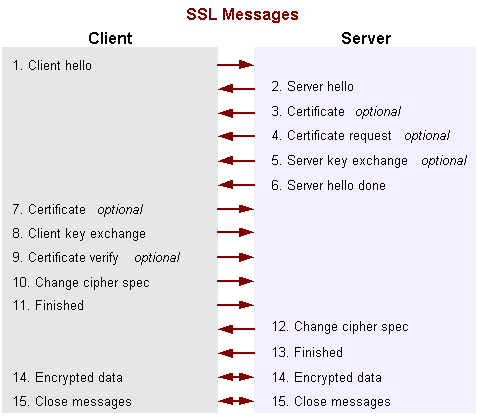
In the first example, the server tries to use a RSA-based ciphersuite such as TLS_RSA_WITH_AES_128_CBC_SHA. The server's
KeyManageris queried, and returns an appropriate RSA entry. The server's credentials (that is: certificate/public key) are sent in the server's Certificate message. The client'sTrustManagerverifies the server's certificate, and if accepted, the client generates some random bytes using aSecureRandomobject. This is then encrypted using an encrypting asymmetric RSACipherobject that has been initialized with thePublicKeyfound in the server's certificate. This encrypted data is sent in a Client Key Exchange message. The server would use its correspondingPrivateKeyto recover the bytes using a similarCipherin decrypt mode. These bytes are then used to establish the actual encryption keys.In a different example, an ephemeral Diffie-Hellman key agreement algorithm along with the DSA signature algorithm is chosen, such as TLS_DHE_DSS_WITH_AES_128_CBC_SHA. The two sides must each establish a new temporary DH public/private keypair using a
KeyPairGenerator. Each generator creates DH keys which can then be further converted into pieces using theKeyFactoryandDHPublicKeySpecclasses. Each side then creates aKeyAgreementobject and initializes it with their respective DHPrivateKeys. The server sends its public key pieces in a ServerKeyExchange message (protected by the DSA signature algorithm, and the client sends its public key in a ClientKeyExchange message. When the public keys are reassembled using anotherKeyFactory, they are fed into the agreement objects. TheKeyAgreementobjects then generate agreed-upon bytes that are then used to establish the actual encryption keys.Once the actual encryption keys have been established, the secret key is used to initialize a symmetric
Cipherobject, and this cipher is used to protect all data in transit. To help determine if the data has been modified, aMessageDigestis created and receives a copy of the data destined for the network. When the packet is complete, the digest (hash) is appended to data, and the entire packet is encrypted by theCipher. If a block cipher such as AES is used, the data must be padded to make a complete block. On the remote side, the steps are simply reversed.
Header Data Digest Padding (if any) Again, this is vastly simplied, but gives one an idea of how these classes might be combined to create a higher level protocol.
How to Make Applications "Exempt" from Cryptographic Restrictions
Note 1: This section should be ignored by most application developers. It is only for people whose applications may be exported to those few countries whose governments mandate cryptographic restrictions, if it is desired that such applications have fewer cryptographic restrictions than those mandated. Note 2: Throughout this section, the term "application" is meant to encompass both applications and applets.]
The JCA framework includes an ability to enforce restrictions regarding the cryptographic algorithms and maximum cryptographic strengths available to applets/applications in different jurisdiction contexts (locations). Any such restrictions are specified in "jurisdiction policy files".
Due to import control restrictions by the governments of a few countries, the jurisdiction policy files shipped with the Java SE Development Kit 6 from Sun Microsystems specify that "strong" but limited cryptography may be used. An "unlimited strength" version of these files indicating no restrictions on cryptographic strengths is available for those living in eligible countries (which is most countries). But only the "strong" version can be imported into those countries whose governments mandate restrictions. The JCA framework will enforce the restrictions specified in the installed jurisdiction policy files.
It is possible that the governments of some or all such countries may allow certain applications to become exempt from some or all cryptographic restrictions. For example, they may consider certain types of applications as "special" and thus exempt. Or they may exempt any application that utilizes an "exemption mechanism," such as key recovery. Applications deemed to be exempt could get access to stronger cryptography than that allowed for non-exempt applications in such countries.
In order for an application to be recognized as "exempt" at runtime, it must meet the following conditions:
- It must have a permission policy file bundled with it in a JAR file. The permission policy file specifies what cryptography-related permissions the application has, and under what conditions (if any).
- The JAR file containing the application and the permission policy file must have been signed using a code-signing certificate issued after the application was accepted as exempt.
Below are sample steps required in order to make an application exempt from some or all cryptographic restrictions. This is a basic outline that includes information about what is required by JCA in order to recognize and treat applications as being exempt. You will need to know the exemption requirements of the particular country or countries in which you would like your application to be able to be run but whose governments require cryptographic restrictions. You will also need to know the requirements of a JCA framework vendor that has a process in place for handling exempt applications. Consult such a vendor for further information. (NOTE: The
SunJCEprovider does not supply an implementation of the ExemptionMechanismSpi class.)
- Step 1: Write and Compile Your Application Code
- Step 2: Create a Permission Policy File Granting Appropriate Cryptographic Permissions
- Step 3: Prepare for Testing
- Step 3a: Apply for Government Approval From the Government Mandating Restrictions.
- Step 3b: Get a Code-Signing Certificate
- Step 3c: Bundle the Application and Permission Policy File into a JAR file
- Step 3d: Sign the JAR file
- Step 3e: Set Up Your Environment Like That of a User in a Restricted Country
- Step 3f: (only for apps using exemption mechanisms) Install a Provider Implementing the Exemption Mechanism Specified by the entry in the Permission Policy File
- Step 4: Test Your Application
- Step 5: Apply for U.S. Government Export Approval If Required
- Step 6: Deploy Your Application
Special Code Requirements for Applications that Use Exemption Mechanisms
When an application has a permission policy file associated with it (in the same JAR file) and that permission policy file specifies an exemption mechanism, then when the Cipher
getInstancemethod is called to instantiate a Cipher, the JCA code searches the installed providers for one that implements the specified exemption mechanism. If it finds such a provider, JCA instantiates an ExemptionMechanism API object associated with the provider's implementation, and then associates the ExemptionMechanism object with the Cipher returned bygetInstance.After instantiating a Cipher, and prior to initializing it (via a call to the Cipher
initmethod), your code must call the following Cipher method:public ExemptionMechanism getExemptionMechanism()This call returns the ExemptionMechanism object associated with the Cipher. You must then initialize the exemption mechanism implementation by calling the following method on the returned ExemptionMechanism:
public final void init(Key key)The argument you supply should be the same as the argument of the same types that you will subsequently supply to a Cipher
initmethod.Once you have initialized the ExemptionMechanism, you can proceed as usual to initialize and use the Cipher.
Permission Policy Files
In order for an application to be recognized at runtime as being "exempt" from some or all cryptographic restrictions, it must have a permission policy file bundled with it in a JAR file. The permission policy file specifies what cryptography-related permissions the application has, and under what conditions (if any).
NOTE: The permission policy file bundled with an application must be namedcryptoPerms.
The format of a permission entry in a permission policy file that accompanies an exempt application is the same as the format for a jurisdiction policy file downloaded with the JDK, which is:
    permission <crypto permission class name>[ <alg_name>
        [[, <exemption mechanism name>][, <maxKeySize>
        [, <AlgorithmParameterSpec class name>,
        <parameters for constructing an AlgorithmParameterSpec object>
	]]]];
See Appendix B for more information about the jurisdiction policy file format.
Permission Policy Files for Exempt Applications
Some applications may be allowed to be completely unrestricted. Thus, the permission policy file that accompanies such an application usually just needs to contain the following:
    grant {
        // There are no restrictions to any algorithms.
        permission javax.crypto.CryptoAllPermission;
    };
If an application just uses a single algorithm (or several specific algorithms), then the permission policy file could simply mention that algorithm (or algorithms) explicitly, rather than granting CryptoAllPermission. For example, if an application just uses the Blowfish algorithm, the permission policy file doesn't have to grant CryptoAllPermission to all algorithms. It could just specify that there is no cryptographic restriction if the Blowfish algorithm is used. In order to do this, the permission policy file would look like the following:
    grant {
        permission javax.crypto.CryptoPermission "Blowfish";
    };
Permission Policy Files for Applications Exempt Due to Exemption Mechanisms
If an application is considered "exempt" if an exemption mechanism is enforced, then the permission policy file that accompanies the application must specify one or more exemption mechanisms. At runtime, the application will be considered exempt if any of those exemption mechanisms is enforced. Each exemption mechanism must be specified in a permission entry that looks like the following:
    // No algorithm restrictions if specified
    // exemption mechanism is enforced.
    permission javax.crypto.CryptoPermission *,
	"<ExemptionMechanismName>";
where
<ExemptionMechanismName>specifies the name of an exemption mechanism. The list of possible exemption mechanism names includes:As an example, suppose your application is exempt if either key recovery or key escrow is enforced. Then your permission policy file should contain the following:
- KeyRecovery
- KeyEscrow
- KeyWeakening
    grant {
	// No algorithm restrictions if KeyRecovery is enforced.
	permission javax.crypto.CryptoPermission *,
	    "KeyRecovery";
	// No algorithm restrictions if KeyEscrow is enforced.
	permission javax.crypto.CryptoPermission *,
	    "KeyEscrow";
    };
NOTE: Permission entries that specify exemption mechanisms should not also specify maximum key sizes. The allowed key sizes are actually determined from the installed exempt jurisdiction policy files, as described in the next section.
How Bundled Permission Policy Files Affect Cryptographic Permissions
At runtime, when an application instantiates a Cipher (via a call to its
getInstancemethod) and that application has an associated permission policy file, JCA checks to see whether the permission policy file has an entry that applies to the algorithm specified in thegetInstancecall. If it does, and the entry grants CryptoAllPermission or does not specify that an exemption mechanism must be enforced, it means there is no cryptographic restriction for this particular algorithm.If the permission policy file has an entry that applies to the algorithm specified in the
getInstancecall and the entry does specify that an exemption mechanism must be enforced, then the exempt jurisdiction policy file(s) are examined. If the exempt permissions include an entry for the relevant algorithm and exemption mechanism, and that entry is implied by the permissions in the permission policy file bundled with the application, and if there is an implementation of the specified exemption mechanism available from one of the registered providers, then the maximum key size and algorithm parameter values for the Cipher are determined from the exempt permission entry.If there is no exempt permission entry implied by the relevant entry in the permission policy file bundled with the application, or if there is no implementation of the specified exemption mechanism available from any of the registered providers, then the application is only allowed the standard default cryptographic permissions.
Code Examples
Here are some short examples which illustrate use of several of the JCA mechanisms. In addition, complete working examples can be found in Appendix D.Computing a
MessageDigestObjectFirst create the message digest object, as in the following example:
This call assigns a properly initialized message digest object to theMessageDigest sha = MessageDigest.getInstance("SHA-1");shavariable. The implementation implements the Secure Hash Algorithm (SHA-1), as defined in the National Institute for Standards and Technology's (NIST) FIPS 180-2 document. See Appendix A for a complete discussion of standard names and algorithms.Next, suppose we have three byte arrays,
i1,i2andi3, which form the total input whose message digest we want to compute. This digest (or "hash") could be calculated via the following calls:sha.update(i1); sha.update(i2); sha.update(i3); byte[] hash = sha.digest();An equivalent alternative series of calls would be:
After the message digest has been calculated, the message digest object is automatically reset and ready to receive new data and calculate its digest. All former state (i.e., the data supplied tosha.update(i1); sha.update(i2); byte[] hash = sha.digest(i3);updatecalls) is lost.Some hash implementations may support intermediate hashes through cloning. Suppose we want to calculate separate hashes for:
i1i1 and i2i1, i2, and i3A way to do it is:
This code works only if the SHA-1 implementation is cloneable. While some implementations of message digests are cloneable, others are not. To determine whether or not cloning is possible, attempt to clone the/* compute the hash for i1 */ sha.update(i1); byte[] i1Hash = sha.clone().digest(); /* compute the hash for i1 and i2 */ sha.update(i2); byte[] i12Hash = sha.clone().digest(); /* compute the hash for i1, i2 and i3 */ sha.update(i3); byte[] i123hash = sha.digest();MessageDigestobject and catch the potential exception as follows:If a message digest is not cloneable, the other, less elegant way to compute intermediate digests is to create several digests. In this case, the number of intermediate digests to be computed must be known in advance:try { // try and clone it /* compute the hash for i1 */ sha.update(i1); byte[] i1Hash = sha.clone().digest(); . . . byte[] i123hash = sha.digest(); } catch (CloneNotSupportedException cnse) { // do something else, such as the code shown below }MessageDigestsha1 = MessageDigest.getInstance("SHA-1");MessageDigestsha12 = MessageDigest.getInstance("SHA-1");MessageDigestsha123 = MessageDigest.getInstance("SHA-1"); byte[] i1Hash = sha1.digest(i1); sha12.update(i1); byte[] i12Hash = sha12.digest(i2); sha123.update(i1); sha123.update(i2); byte[] i123Hash = sha123.digest(i3);Generating a Pair of Keys
In this example we will generate a public-private key pair for the algorithm named "DSA" (Digital Signature Algorithm), and use this keypair in future examples. We will generate keys with a 1024-bit modulus. We don't care which provider supplies the algorithm implementation.
Creating the Key Pair Generator
The first step is to get a key pair generator object for generating keys for the DSA algorithm:
KeyPairGenerator keyGen = KeyPairGenerator.getInstance("DSA");Initializing the Key Pair Generator
The next step is to initialize the key pair generator. In most cases, algorithm-independent initialization is sufficient, but in some cases, algorithm-specific initialization is used.Algorithm-Independent Initialization
All key pair generators share the concepts of a keysize and a source of randomness. The
KeyPairGeneratorclass initialization methods at a minimum needs a keysize. If the source of randomness is not explicitly provided, aSecureRandomimplementation of the highest-priority installed provider will be used. Thus to generate keys with a keysize of 1024, simply call:The following code illustrates how to use a specific, additionally seededSecureRandom random = SecureRandom.getInstance("SHA1PRNG", "SUN"); keyGen.initialize(1024, random);SecureRandomobject:Since no other parameters are specified when you call the above algorithm-independentSecureRandom random = SecureRandom.getInstance("SHA1PRNG", "SUN"); random.setSeed(userSeed); keyGen.initialize(1024, random);initializemethod, it is up to the provider what to do about the algorithm-specific parameters (if any) to be associated with each of the keys. The provider may use precomputed parameter values or may generate new values.Algorithm-Specific Initialization
For situations where a set of algorithm-specific parameters already exists (such as "community parameters" in DSA), there are two
initializemethods that have anAlgorithmParameterSpecargument. Suppose your key pair generator is for the "DSA" algorithm, and you have a set of DSA-specific parameters,p,q, andg, that you would like to use to generate your key pair. You could execute the following code to initialize your key pair generator (recall thatDSAParameterSpecis an AlgorithmParameterSpec):DSAParameterSpec dsaSpec = new DSAParameterSpec(p, q, g); SecureRandom random = SecureRandom.getInstance("SHA1PRNG", "SUN"); random.setSeed(userSeed); keyGen.initialize(dsaSpec, random);
NOTE: The parameter namedpis a prime number whose length is the modulus length ("size"). Therefore, you don't need to call any other method to specify the modulus length.
Generating the Pair of Keys
The final step is actually generating the key pair. No matter which type of initialization was used (algorithm-independent or algorithm-specific), the same code is used to generate the key pair:KeyPair pair = keyGen.generateKeyPair();Generating and Verifying a Signature Using Generated Keys
The following signature generation and verification examples use the
KeyPairgenerated in the key pair example above.Generating a Signature
We first create a signature object:
Next, using the key pair generated in the key pair example, we initialize the object with the private key, then sign a byte array calledSignature dsa = Signature.getInstance("SHA1withDSA");data./* Initializing the object with a private key */ PrivateKey priv = pair.getPrivate(); dsa.initSign(priv); /* Update and sign the data */ dsa.update(data); byte[] sig = dsa.sign();Verifying a Signature
Verifying the signature is straightforward. (Note that here we also use the key pair generated in the key pair example.)/* Initializing the object with the public key */ PublicKey pub = pair.getPublic(); dsa.initVerify(pub); /* Update and verify the data */ dsa.update(data); boolean verifies = dsa.verify(sig); System.out.println("signature verifies: " + verifies);Generating/Verifying Signatures Using Key Specifications and
KeyFactorySuppose that, rather than having a public/private key pair (as, for example, was generated in the key pair example above), you simply have the components of your DSA private key:x(the private key),p(the prime),q(the sub-prime), andg(the base).Further suppose you want to use your private key to digitally sign some data, which is in a byte array named
someData. You would do the following steps, which also illustrate creating a key specification and using a key factory to obtain aPrivateKeyfrom the key specification (initSignrequires aPrivateKey):Suppose Alice wants to use the data you signed. In order for her to do so, and to verify your signature, you need to send her three things:DSAPrivateKeySpec dsaPrivKeySpec = new DSAPrivateKeySpec(x, p, q, g); KeyFactory keyFactory = KeyFactory.getInstance("DSA"); PrivateKey privKey = keyFactory.generatePrivate(dsaPrivKeySpec); Signature sig = Signature.getInstance("SHA1withDSA"); sig.initSign(privKey); sig.update(someData); byte[] signature = sig.sign();You can store the
- the data,
- the signature, and
- the public key corresponding to the private key you used to sign the data.
someDatabytes in one file, and thesignaturebytes in another, and send those to Alice.For the public key, assume, as in the signing example above, you have the components of the DSA public key corresponding to the DSA private key used to sign the data. Then you can create a
DSAPublicKeySpecfrom those components:You still need to extract the key bytes so that you can put them in a file. To do so, you can first call theDSAPublicKeySpec dsaPubKeySpec = new DSAPublicKeySpec(y, p, q, g);generatePublicmethod on the DSA key factory already created in the example above:Then you can extract the (encoded) key bytes via the following:PublicKey pubKey = keyFactory.generatePublic(dsaPubKeySpec);You can now store these bytes in a file, and send it to Alice along with the files containing the data and the signature.byte[] encKey = pubKey.getEncoded();Now, assume Alice has received these files, and she copied the data bytes from the data file to a byte array named
data, the signature bytes from the signature file to a byte array namedsignature, and the encoded public key bytes from the public key file to a byte array namedencodedPubKey.Alice can now execute the following code to verify the signature. The code also illustrates how to use a key factory in order to instantiate a DSA public key from its encoding (
initVerifyrequires aPublicKey).X509EncodedKeySpec pubKeySpec = new X509EncodedKeySpec(encodedPubKey); KeyFactory keyFactory = KeyFactory.getInstance("DSA"); PublicKey pubKey = keyFactory.generatePublic(pubKeySpec); Signature sig = Signature.getInstance("SHA1withDSA"); sig.initVerify(pubKey); sig.update(data); sig.verify(signature);NOTE: In the above, Alice needed to generate aPublicKeyfrom the encoded key bits, sinceinitVerifyrequires aPublicKey. Once she has aPublicKey, she could also use theKeyFactorygetKeySpecmethod to convert it to aDSAPublicKeySpecso that she can access the components, if desired, as in:DSAPublicKeySpec dsaPubKeySpec = (DSAPublicKeySpec)keyFactory.getKeySpec(pubKey, DSAPublicKeySpec.class)Now she can access the DSA public key componentsy,p,q, andgthrough the corresponding "get" methods on theDSAPublicKeySpecclass (getY,getP,getQ, andgetG).Determining If Two Keys Are Equal
In many cases you would like to know if two keys are equal; however, the default method
java.lang.Object.equalsmay not give the desired result. The most provider-independent approach is to compare the encoded keys. If this comparison isn't appropriate (for example, when comparing anRSAPrivateKeyand anRSAPrivateCrtKey), you should compare each component. The following code demonstrates this idea:static boolean keysEqual(Key key1, Key key2) { if (key1.equals(key2)) { return true; } if (Arrays.equals(key1.getEncoded(), key2.getEncoded())) { return true; } // More code for different types of keys here. // For example, the following code can check if // an RSAPrivateKey and an RSAPrivateCrtKey are equal: // if ((key1 instanceof RSAPrivateKey) && // (key2 instanceof RSAPrivateKey)) { // if ((key1.getModulus().equals(key2.getModulus())) && // (key1.getPrivateExponent().equals( // key2.getPrivateExponent()))) { // return true; // } // } return false; }Reading Base64-Encoded Certificates
The following example reads a file with Base64-encoded certificates, which are each bounded at the beginning by
-----BEGIN CERTIFICATE-----and at the end by-----END CERTIFICATE-----We convert theFileInputStream(which does not supportmarkandreset) to aByteArrayInputStream(which supports those methods), so that each call togenerateCertificateconsumes only one certificate, and the read position of the input stream is positioned to the next certificate in the file:
FileInputStream fis = new FileInputStream(filename);
BufferedInputStream bis = new BufferedInputStream(fis);

CertificateFactory cf = CertificateFactory.getInstance("X.509");

while (bis.available() > 0) {
    Certificate cert = cf.generateCertificate(bis);
    System.out.println(cert.toString());
}
Parsing a Certificate Reply
The following example parses a PKCS7-formatted certificate reply stored in a file and extracts all the certificates from it:
FileInputStream fis = new FileInputStream(filename);
CertificateFactory cf = CertificateFactory.getInstance("X.509");
Collection c = cf.generateCertificates(fis);
Iterator i = c.iterator();
while (i.hasNext()) {
   Certificate cert = (Certificate)i.next();
   System.out.println(cert);
}
Using Encryption
This section takes the user through the process of generating a key, creating and initializing a cipher object, encrypting a file, and then decrypting it. Throughout this example, we use the Advanced Encryption Standard (AES).
Generating a Key
To create an AES key, we have to instantiate a KeyGenerator for AES. We do not specify a provider, because we do not care about a particular AES key generation implementation. Since we do not initialize the KeyGenerator, a system-provided source of randomness and a default keysize will be used to create the AES key:
    KeyGenerator keygen = KeyGenerator.getInstance("AES");
    SecretKey aesKey = keygen.generateKey();
After the key has been generated, the same KeyGenerator object can be re-used to create further keys.
Creating a Cipher
The next step is to create a Cipher instance. To do this, we use one of the
getInstancefactory methods of the Cipher class. We must specify the name of the requested transformation, which includes the following components, separated by slashes (/):
- the algorithm name
- the mode (optional)
- the padding scheme (optional)
In this example, we create an AES cipher in Electronic Codebook mode, with PKCS5-style padding. We do not specify a provider, because we do not care about a particular implementation of the requested transformation.
The standard algorithm name for AES is "AES", the standard name for the Electronic Codebook mode is "ECB", and the standard name for PKCS5-style padding is "PKCS5Padding":
    Cipher aesCipher;

    // Create the cipher
    aesCipher = Cipher.getInstance("AES/ECB/PKCS5Padding");
We use the generated
aesKeyfrom above to initialize the Cipher object for encryption:// Initialize the cipher for encryption aesCipher.init(Cipher.ENCRYPT_MODE, aesKey); // Our cleartext byte[] cleartext = "This is just an example".getBytes(); // Encrypt the cleartext byte[] ciphertext = aesCipher.doFinal(cleartext); // Initialize the same cipher for decryption aesCipher.init(Cipher.DECRYPT_MODE, aesKey); // Decrypt the ciphertext byte[] cleartext1 = aesCipher.doFinal(ciphertext);
cleartextandcleartext1are identical.Using Password-Based Encryption
In this example, we prompt the user for a password from which we derive an encryption key.
It would seem logical to collect and store the password in an object of type
java.lang.String. However, here's the caveat: Objects of typeStringare immutable, i.e., there are no methods defined that allow you to change (overwrite) or zero out the contents of aStringafter usage. This feature makesStringobjects unsuitable for storing security sensitive information such as user passwords. You should always collect and store security sensitive information in a char array instead.For that reason, the
javax.crypto.spec.PBEKeySpecclass takes (and returns) a password as a char array. See the ReadPassword class in the sample code in Appendix D for one possible way of reading character array passwords from an input stream.In order to use Password-Based Encryption (PBE) as defined in PKCS5, we have to specify a salt and an iteration count. The same salt and iteration count that are used for encryption must be used for decryption:
	    PBEKeySpec pbeKeySpec;
	    PBEParameterSpec pbeParamSpec;
	    SecretKeyFactory keyFac;

	    // Salt
	    byte[] salt = {
		(byte)0xc7, (byte)0x73, (byte)0x21, (byte)0x8c,
		(byte)0x7e, (byte)0xc8, (byte)0xee, (byte)0x99
	    };

	    // Iteration count
	    int count = 20;

	    // Create PBE parameter set
	    pbeParamSpec = new PBEParameterSpec(salt, count);

	    // Prompt user for encryption password.
	    // Collect user password as char array (using the
	    // "readPassword" method from above), and convert
	    // it into a SecretKey object, using a PBE key
	    // factory.
	    System.out.print("Enter encryption password:  ");
	    System.out.flush();
	    pbeKeySpec = new PBEKeySpec(readPassword(System.in));
	    keyFac = SecretKeyFactory.getInstance("PBEWithMD5AndDES");
	    SecretKey pbeKey = keyFac.generateSecret(pbeKeySpec);

	    // Create PBE Cipher
	    Cipher pbeCipher = Cipher.getInstance("PBEWithMD5AndDES");

	    // Initialize PBE Cipher with key and parameters
	    pbeCipher.init(Cipher.ENCRYPT_MODE, pbeKey, pbeParamSpec);

	    // Our cleartext
	    byte[] cleartext = "This is another example".getBytes();

	    // Encrypt the cleartext
	    byte[] ciphertext = pbeCipher.doFinal(cleartext);
Using Key Agreement
Please refer to Appendix D for sample programs exercising the Diffie-Hellman key exchange between 2 and 3 parties.
Appendix A: Standard Names
The JDK Security API requires and uses a set of standard names for algorithms, certificate and keystore types. The specification names previously found here in Appendix A and in the other security specifications (JSSE/CertPath/etc.) have been combined in the Standard Names document. This document also contains more information about the algorithm specifications. Specific provider information can be found in the Sun Provider Documentation.
Cryptographic implementations in the Sun JDK are distributed through several different providers primarily for historical reasons (
Sun,SunJSSE,SunJCE,SunRsaSign). Note these providers may not be available on all JDK implementations, and therefore, truly portable applications should callgetInstance()without specifying specific providers. Applications specifying a particular provider may not be able to take advantage of native providers tuned for an underlying operating environment (such as PKCS or Microsoft's CAPI).The
SunPKCS11provider itself does not contain any cryptographic algorithms, but instead, directs requests into an underlying PKCS11 implementation. The PKCS11 Reference Guide and the underlying PKCS11 implementation should be consulted to determine if a desired algorithm will be available through the PKCS11 provider. Likewise, on Windows systems, theSunMSCAPIprovider does not provide any cryptographic functionality, but instead routes requests to the underlying Operating System for handling.
Appendix B: Jurisdiction Policy File Format
JCA represents its jurisdiction policy files as Java style policy files with corresponding permission statements. As described in Default Policy Implementation and Policy File Syntax, a Java policy file specifies what permissions are allowed for code from specified code sources. A permission represents access to a system resource. In the case of JCA, the "resources" are cryptography algorithms, and code sources do not need to be specified, because the cryptographic restrictions apply to all code.
A jurisdiction policy file consists of a very basic "grant entry" containing one or more "permission entries."
grant {
    <permission entries>;
};
The format of a permission entry in a jurisdiction policy file is:
permission <crypto permission class name>[ <alg_name>
    [[, <exemption mechanism name>][, <maxKeySize>
    [, <AlgorithmParameterSpec class name>,
    <parameters for constructing an
	AlgorithmParameterSpec object>]]]];
A sample jurisdiction policy file that includes restricting the "Blowfish" algorithm to maximum key sizes of 64 bits is:
    grant {
        permission javax.crypto.CryptoPermission "Blowfish", 64;
	. . .;
    };
A permission entry must begin with the word
permission. The<crypto permission class name>in the template above would actually be a specific permission class name, such asjavax.crypto.CryptoPermission. A crypto permission class reflects the ability of an application/applet to use certain algorithms with certain key sizes in certain environments. There are two crypto permission classes:CryptoPermissionandCryptoAllPermission. The specialCryptoAllPermissionclass implies all cryptography-related permissions, that is, it specifies that there are no cryptography-related restrictions.The <alg_name>, when utilized, is a quoted string specifying the standard name (see Appendix A) of a cryptography algorithm, such as "DES" or "RSA".
The <exemption mechanism name>, when specified, is a quoted string indicating an exemption mechanism which, if enforced, enables a reduction in cryptographic restrictions. Exemption mechanism names that can be used include "KeyRecovery" "KeyEscrow", and "KeyWeakening".
<maxKeySize> is an integer specifying the maximum key size (in bits) allowed for the specified algorithm.
For some algorithms it may not be sufficient to specify the algorithm strength in terms of just a key size. For example, in the case of the "RC5" algorithm, the number of rounds must also be considered. For algorithms whose strength needs to be expressed as more than a key size, the permission entry should also specify an AlgorithmParameterSpec class name (such as
javax.crypto.spec.RC5ParameterSpec) and a list of parameters for constructing the specified AlgorithmParameterSpec object.Items that appear in a permission entry must appear in the specified order. An entry is terminated with a semicolon.
Case is unimportant for the identifiers (
grant,permission) but is significant for the<crypto permission class name>or for any string that is passed in as a value.NOTE: An "*" can be used as a wildcard for any permission entry option. For example, an "*" (without the quotes) for an <alg_name> option means "all algorithms."
Appendix C: Maximum Key Sizes Allowed by "Strong" Jurisdiction Policy Files
Due to import control restrictions, the jurisdiction policy files shipped with the Java SE Development Kit 6 allow "strong" but limited cryptography to be used. Here are the maximum key sizes allowed by this "strong" version of the jurisdiction policy files:
Algorithm Maximum Keysize DES 64 DESede * RC2 128 RC4 128 RC5 128 RSA * all others 128
Appendix D: Sample Programs
-
Diffie-Hellman Key Exchange between 2 Parties
/* * Copyright 1997-2001 by Sun Microsystems, Inc., * 901 San Antonio Road, Palo Alto, California, 94303, U.S.A. * All rights reserved. * * This software is the confidential and proprietary information * of Sun Microsystems, Inc. ("Confidential Information"). You * shall not disclose such Confidential Information and shall use * it only in accordance with the terms of the license agreement * you entered into with Sun. */ import java.io.*; import java.math.BigInteger; import java.security.*; import java.security.spec.*; import java.security.interfaces.*; import javax.crypto.*; import javax.crypto.spec.*; import javax.crypto.interfaces.*; import com.sun.crypto.provider.SunJCE; /** * This program executes the Diffie-Hellman key agreement protocol * between 2 parties: Alice and Bob. * * By default, preconfigured parameters (1024-bit prime modulus and base * generator used by SKIP) are used. * If this program is called with the "-gen" option, a new set of * parameters is created. */ public class DHKeyAgreement2 { private DHKeyAgreement2() {} public static void main(String argv[]) { try { String mode = "USE_SKIP_DH_PARAMS"; DHKeyAgreement2 keyAgree = new DHKeyAgreement2(); if (argv.length > 1) { keyAgree.usage(); throw new Exception("Wrong number of command options"); } else if (argv.length == 1) { if (!(argv[0].equals("-gen"))) { keyAgree.usage(); throw new Exception("Unrecognized flag: " + argv[0]); } mode = "GENERATE_DH_PARAMS"; } keyAgree.run(mode); } catch (Exception e) { System.err.println("Error: " + e); System.exit(1); } } private void run(String mode) throws Exception { DHParameterSpec dhSkipParamSpec; if (mode.equals("GENERATE_DH_PARAMS")) { // Some central authority creates new DH parameters System.out.println ("Creating Diffie-Hellman parameters (takes VERY long) ..."); AlgorithmParameterGenerator paramGen = AlgorithmParameterGenerator.getInstance("DH"); paramGen.init(512); AlgorithmParameters params = paramGen.generateParameters(); dhSkipParamSpec = (DHParameterSpec)params.getParameterSpec (DHParameterSpec.class); } else { // use some pre-generated, default DH parameters System.out.println("Using SKIP Diffie-Hellman parameters"); dhSkipParamSpec = new DHParameterSpec(skip1024Modulus, skip1024Base); } /* * Alice creates her own DH key pair, using the DH parameters from * above */ System.out.println("ALICE: Generate DH keypair ..."); KeyPairGenerator aliceKpairGen = KeyPairGenerator.getInstance("DH"); aliceKpairGen.initialize(dhSkipParamSpec); KeyPair aliceKpair = aliceKpairGen.generateKeyPair(); // Alice creates and initializes her DH KeyAgreement object System.out.println("ALICE: Initialization ..."); KeyAgreement aliceKeyAgree = KeyAgreement.getInstance("DH"); aliceKeyAgree.init(aliceKpair.getPrivate()); // Alice encodes her public key, and sends it over to Bob. byte[] alicePubKeyEnc = aliceKpair.getPublic().getEncoded(); /* * Let's turn over to Bob. Bob has received Alice's public key * in encoded format. * He instantiates a DH public key from the encoded key material. */ KeyFactory bobKeyFac = KeyFactory.getInstance("DH"); X509EncodedKeySpec x509KeySpec = new X509EncodedKeySpec (alicePubKeyEnc); PublicKey alicePubKey = bobKeyFac.generatePublic(x509KeySpec); /* * Bob gets the DH parameters associated with Alice's public key. * He must use the same parameters when he generates his own key * pair. */ DHParameterSpec dhParamSpec = ((DHPublicKey)alicePubKey).getParams(); // Bob creates his own DH key pair System.out.println("BOB: Generate DH keypair ..."); KeyPairGenerator bobKpairGen = KeyPairGenerator.getInstance("DH"); bobKpairGen.initialize(dhParamSpec); KeyPair bobKpair = bobKpairGen.generateKeyPair(); // Bob creates and initializes his DH KeyAgreement object System.out.println("BOB: Initialization ..."); KeyAgreement bobKeyAgree = KeyAgreement.getInstance("DH"); bobKeyAgree.init(bobKpair.getPrivate()); // Bob encodes his public key, and sends it over to Alice. byte[] bobPubKeyEnc = bobKpair.getPublic().getEncoded(); /* * Alice uses Bob's public key for the first (and only) phase * of her version of the DH * protocol. * Before she can do so, she has to instantiate a DH public key * from Bob's encoded key material. */ KeyFactory aliceKeyFac = KeyFactory.getInstance("DH"); x509KeySpec = new X509EncodedKeySpec(bobPubKeyEnc); PublicKey bobPubKey = aliceKeyFac.generatePublic(x509KeySpec); System.out.println("ALICE: Execute PHASE1 ..."); aliceKeyAgree.doPhase(bobPubKey, true); /* * Bob uses Alice's public key for the first (and only) phase * of his version of the DH * protocol. */ System.out.println("BOB: Execute PHASE1 ..."); bobKeyAgree.doPhase(alicePubKey, true); /* * At this stage, both Alice and Bob have completed the DH key * agreement protocol. * Both generate the (same) shared secret. */ byte[] aliceSharedSecret = aliceKeyAgree.generateSecret(); int aliceLen = aliceSharedSecret.length; byte[] bobSharedSecret = new byte[aliceLen]; int bobLen; try { // show example of what happens if you // provide an output buffer that is too short bobLen = bobKeyAgree.generateSecret(bobSharedSecret, 1); } catch (ShortBufferException e) { System.out.println(e.getMessage()); } // provide output buffer of required size bobLen = bobKeyAgree.generateSecret(bobSharedSecret, 0); System.out.println("Alice secret: " + toHexString(aliceSharedSecret)); System.out.println("Bob secret: " + toHexString(bobSharedSecret)); if (!java.util.Arrays.equals(aliceSharedSecret, bobSharedSecret)) throw new Exception("Shared secrets differ"); System.out.println("Shared secrets are the same"); /* * Now let's return the shared secret as a SecretKey object * and use it for encryption. First, we generate SecretKeys for the * "DES" algorithm (based on the raw shared secret data) and * then we use DES in ECB mode * as the encryption algorithm. DES in ECB mode does not require any * parameters. * * Then we use DES in CBC mode, which requires an initialization * vector (IV) parameter. In CBC mode, you need to initialize the * Cipher object with an IV, which can be supplied using the * javax.crypto.spec.IvParameterSpec class. Note that you have to use * the same IV for encryption and decryption: If you use a different * IV for decryption than you used for encryption, decryption will * fail. * * NOTE: If you do not specify an IV when you initialize the * Cipher object for encryption, the underlying implementation * will generate a random one, which you have to retrieve using the * javax.crypto.Cipher.getParameters() method, which returns an * instance of java.security.AlgorithmParameters. You need to transfer * the contents of that object (e.g., in encoded format, obtained via * the AlgorithmParameters.getEncoded() method) to the party who will * do the decryption. When initializing the Cipher for decryption, * the (reinstantiated) AlgorithmParameters object must be passed to * the Cipher.init() method. */ System.out.println("Return shared secret as SecretKey object ..."); // Bob // NOTE: The call to bobKeyAgree.generateSecret above reset the key // agreement object, so we call doPhase again prior to another // generateSecret call bobKeyAgree.doPhase(alicePubKey, true); SecretKey bobDesKey = bobKeyAgree.generateSecret("DES"); // Alice // NOTE: The call to aliceKeyAgree.generateSecret above reset the key // agreement object, so we call doPhase again prior to another // generateSecret call aliceKeyAgree.doPhase(bobPubKey, true); SecretKey aliceDesKey = aliceKeyAgree.generateSecret("DES"); /* * Bob encrypts, using DES in ECB mode */ Cipher bobCipher = Cipher.getInstance("DES/ECB/PKCS5Padding"); bobCipher.init(Cipher.ENCRYPT_MODE, bobDesKey); byte[] cleartext = "This is just an example".getBytes(); byte[] ciphertext = bobCipher.doFinal(cleartext); /* * Alice decrypts, using DES in ECB mode */ Cipher aliceCipher = Cipher.getInstance("DES/ECB/PKCS5Padding"); aliceCipher.init(Cipher.DECRYPT_MODE, aliceDesKey); byte[] recovered = aliceCipher.doFinal(ciphertext); if (!java.util.Arrays.equals(cleartext, recovered)) throw new Exception("DES in CBC mode recovered text is " + "different from cleartext"); System.out.println("DES in ECB mode recovered text is " + "same as cleartext"); /* * Bob encrypts, using DES in CBC mode */ bobCipher = Cipher.getInstance("DES/CBC/PKCS5Padding"); bobCipher.init(Cipher.ENCRYPT_MODE, bobDesKey); cleartext = "This is just an example".getBytes(); ciphertext = bobCipher.doFinal(cleartext); // Retrieve the parameter that was used, and transfer it to Alice in // encoded format byte[] encodedParams = bobCipher.getParameters().getEncoded(); /* * Alice decrypts, using DES in CBC mode */ // Instantiate AlgorithmParameters object from parameter encoding // obtained from Bob AlgorithmParameters params = AlgorithmParameters.getInstance("DES"); params.init(encodedParams); aliceCipher = Cipher.getInstance("DES/CBC/PKCS5Padding"); aliceCipher.init(Cipher.DECRYPT_MODE, aliceDesKey, params); recovered = aliceCipher.doFinal(ciphertext); if (!java.util.Arrays.equals(cleartext, recovered)) throw new Exception("DES in CBC mode recovered text is " + "different from cleartext"); System.out.println("DES in CBC mode recovered text is " + "same as cleartext"); } /* * Converts a byte to hex digit and writes to the supplied buffer */ private void byte2hex(byte b, StringBuffer buf) { char[] hexChars = { '0', '1', '2', '3', '4', '5', '6', '7', '8', '9', 'A', 'B', 'C', 'D', 'E', 'F' }; int high = ((b & 0xf0) >> 4); int low = (b & 0x0f); buf.append(hexChars[high]); buf.append(hexChars[low]); } /* * Converts a byte array to hex string */ private String toHexString(byte[] block) { StringBuffer buf = new StringBuffer(); int len = block.length; for (int i = 0; i < len; i++) { byte2hex(block[i], buf); if (i < len-1) { buf.append(":"); } } return buf.toString(); } /* * Prints the usage of this test. */ private void usage() { System.err.print("DHKeyAgreement usage: "); System.err.println("[-gen]"); } // The 1024 bit Diffie-Hellman modulus values used by SKIP private static final byte skip1024ModulusBytes[] = { (byte)0xF4, (byte)0x88, (byte)0xFD, (byte)0x58, (byte)0x4E, (byte)0x49, (byte)0xDB, (byte)0xCD, (byte)0x20, (byte)0xB4, (byte)0x9D, (byte)0xE4, (byte)0x91, (byte)0x07, (byte)0x36, (byte)0x6B, (byte)0x33, (byte)0x6C, (byte)0x38, (byte)0x0D, (byte)0x45, (byte)0x1D, (byte)0x0F, (byte)0x7C, (byte)0x88, (byte)0xB3, (byte)0x1C, (byte)0x7C, (byte)0x5B, (byte)0x2D, (byte)0x8E, (byte)0xF6, (byte)0xF3, (byte)0xC9, (byte)0x23, (byte)0xC0, (byte)0x43, (byte)0xF0, (byte)0xA5, (byte)0x5B, (byte)0x18, (byte)0x8D, (byte)0x8E, (byte)0xBB, (byte)0x55, (byte)0x8C, (byte)0xB8, (byte)0x5D, (byte)0x38, (byte)0xD3, (byte)0x34, (byte)0xFD, (byte)0x7C, (byte)0x17, (byte)0x57, (byte)0x43, (byte)0xA3, (byte)0x1D, (byte)0x18, (byte)0x6C, (byte)0xDE, (byte)0x33, (byte)0x21, (byte)0x2C, (byte)0xB5, (byte)0x2A, (byte)0xFF, (byte)0x3C, (byte)0xE1, (byte)0xB1, (byte)0x29, (byte)0x40, (byte)0x18, (byte)0x11, (byte)0x8D, (byte)0x7C, (byte)0x84, (byte)0xA7, (byte)0x0A, (byte)0x72, (byte)0xD6, (byte)0x86, (byte)0xC4, (byte)0x03, (byte)0x19, (byte)0xC8, (byte)0x07, (byte)0x29, (byte)0x7A, (byte)0xCA, (byte)0x95, (byte)0x0C, (byte)0xD9, (byte)0x96, (byte)0x9F, (byte)0xAB, (byte)0xD0, (byte)0x0A, (byte)0x50, (byte)0x9B, (byte)0x02, (byte)0x46, (byte)0xD3, (byte)0x08, (byte)0x3D, (byte)0x66, (byte)0xA4, (byte)0x5D, (byte)0x41, (byte)0x9F, (byte)0x9C, (byte)0x7C, (byte)0xBD, (byte)0x89, (byte)0x4B, (byte)0x22, (byte)0x19, (byte)0x26, (byte)0xBA, (byte)0xAB, (byte)0xA2, (byte)0x5E, (byte)0xC3, (byte)0x55, (byte)0xE9, (byte)0x2F, (byte)0x78, (byte)0xC7 }; // The SKIP 1024 bit modulus private static final BigInteger skip1024Modulus = new BigInteger(1, skip1024ModulusBytes); // The base used with the SKIP 1024 bit modulus private static final BigInteger skip1024Base = BigInteger.valueOf(2); } -
Diffie-Hellman Key Exchange between 3 Parties
/* * Copyright 1997-2001 by Sun Microsystems, Inc., * 901 San Antonio Road, Palo Alto, California, 94303, U.S.A. * All rights reserved. * * This software is the confidential and proprietary information * of Sun Microsystems, Inc. ("Confidential Information"). You * shall not disclose such Confidential Information and shall use * it only in accordance with the terms of the license agreement * you entered into with Sun. */ import java.io.*; import java.math.BigInteger; import java.security.*; import java.security.spec.*; import java.security.interfaces.*; import javax.crypto.*; import javax.crypto.spec.*; import javax.crypto.interfaces.*; import com.sun.crypto.provider.SunJCE; /** * This program executes the Diffie-Hellman key agreement protocol * between 3 parties: Alice, Bob, and Carol. * * We use the same 1024-bit prime modulus and base generator that are * used by SKIP. */ public class DHKeyAgreement3 { private DHKeyAgreement3() {} public static void main(String argv[]) { try { DHKeyAgreement3 keyAgree = new DHKeyAgreement3(); keyAgree.run(); } catch (Exception e) { System.err.println("Error: " + e); System.exit(1); } } private void run() throws Exception { DHParameterSpec dhSkipParamSpec; System.out.println("Using SKIP Diffie-Hellman parameters"); dhSkipParamSpec = new DHParameterSpec(skip1024Modulus, skip1024Base); // Alice creates her own DH key pair System.out.println("ALICE: Generate DH keypair ..."); KeyPairGenerator aliceKpairGen = KeyPairGenerator.getInstance("DH"); aliceKpairGen.initialize(dhSkipParamSpec); KeyPair aliceKpair = aliceKpairGen.generateKeyPair(); // Bob creates his own DH key pair System.out.println("BOB: Generate DH keypair ..."); KeyPairGenerator bobKpairGen = KeyPairGenerator.getInstance("DH"); bobKpairGen.initialize(dhSkipParamSpec); KeyPair bobKpair = bobKpairGen.generateKeyPair(); // Carol creates her own DH key pair System.out.println("CAROL: Generate DH keypair ..."); KeyPairGenerator carolKpairGen = KeyPairGenerator.getInstance("DH"); carolKpairGen.initialize(dhSkipParamSpec); KeyPair carolKpair = carolKpairGen.generateKeyPair(); // Alice initialize System.out.println("ALICE: Initialize ..."); KeyAgreement aliceKeyAgree = KeyAgreement.getInstance("DH"); aliceKeyAgree.init(aliceKpair.getPrivate()); // Bob initialize System.out.println("BOB: Initialize ..."); KeyAgreement bobKeyAgree = KeyAgreement.getInstance("DH"); bobKeyAgree.init(bobKpair.getPrivate()); // Carol initialize System.out.println("CAROL: Initialize ..."); KeyAgreement carolKeyAgree = KeyAgreement.getInstance("DH"); carolKeyAgree.init(carolKpair.getPrivate()); // Alice uses Carol's public key Key ac = aliceKeyAgree.doPhase(carolKpair.getPublic(), false); // Bob uses Alice's public key Key ba = bobKeyAgree.doPhase(aliceKpair.getPublic(), false); // Carol uses Bob's public key Key cb = carolKeyAgree.doPhase(bobKpair.getPublic(), false); // Alice uses Carol's result from above aliceKeyAgree.doPhase(cb, true); // Bob uses Alice's result from above bobKeyAgree.doPhase(ac, true); // Carol uses Bob's result from above carolKeyAgree.doPhase(ba, true); // Alice, Bob and Carol compute their secrets byte[] aliceSharedSecret = aliceKeyAgree.generateSecret(); System.out.println("Alice secret: " + toHexString(aliceSharedSecret)); byte[] bobSharedSecret = bobKeyAgree.generateSecret(); System.out.println("Bob secret: " + toHexString(bobSharedSecret)); byte[] carolSharedSecret = carolKeyAgree.generateSecret(); System.out.println("Carol secret: " + toHexString(carolSharedSecret)); // Compare Alice and Bob if (!java.util.Arrays.equals(aliceSharedSecret, bobSharedSecret)) throw new Exception("Alice and Bob differ"); System.out.println("Alice and Bob are the same"); // Compare Bob and Carol if (!java.util.Arrays.equals(bobSharedSecret, carolSharedSecret)) throw new Exception("Bob and Carol differ"); System.out.println("Bob and Carol are the same"); } /* * Converts a byte to hex digit and writes to the supplied buffer */ private void byte2hex(byte b, StringBuffer buf) { char[] hexChars = { '0', '1', '2', '3', '4', '5', '6', '7', '8', '9', 'A', 'B', 'C', 'D', 'E', 'F' }; int high = ((b & 0xf0) >> 4); int low = (b & 0x0f); buf.append(hexChars[high]); buf.append(hexChars[low]); } /* * Converts a byte array to hex string */ private String toHexString(byte[] block) { StringBuffer buf = new StringBuffer(); int len = block.length; for (int i = 0; i < len; i++) { byte2hex(block[i], buf); if (i < len-1) { buf.append(":"); } } return buf.toString(); } /* * Prints the usage of this test. */ private void usage() { System.err.print("DHKeyAgreement usage: "); System.err.println("[-gen]"); } // The 1024 bit Diffie-Hellman modulus values used by SKIP private static final byte skip1024ModulusBytes[] = { (byte)0xF4, (byte)0x88, (byte)0xFD, (byte)0x58, (byte)0x4E, (byte)0x49, (byte)0xDB, (byte)0xCD, (byte)0x20, (byte)0xB4, (byte)0x9D, (byte)0xE4, (byte)0x91, (byte)0x07, (byte)0x36, (byte)0x6B, (byte)0x33, (byte)0x6C, (byte)0x38, (byte)0x0D, (byte)0x45, (byte)0x1D, (byte)0x0F, (byte)0x7C, (byte)0x88, (byte)0xB3, (byte)0x1C, (byte)0x7C, (byte)0x5B, (byte)0x2D, (byte)0x8E, (byte)0xF6, (byte)0xF3, (byte)0xC9, (byte)0x23, (byte)0xC0, (byte)0x43, (byte)0xF0, (byte)0xA5, (byte)0x5B, (byte)0x18, (byte)0x8D, (byte)0x8E, (byte)0xBB, (byte)0x55, (byte)0x8C, (byte)0xB8, (byte)0x5D, (byte)0x38, (byte)0xD3, (byte)0x34, (byte)0xFD, (byte)0x7C, (byte)0x17, (byte)0x57, (byte)0x43, (byte)0xA3, (byte)0x1D, (byte)0x18, (byte)0x6C, (byte)0xDE, (byte)0x33, (byte)0x21, (byte)0x2C, (byte)0xB5, (byte)0x2A, (byte)0xFF, (byte)0x3C, (byte)0xE1, (byte)0xB1, (byte)0x29, (byte)0x40, (byte)0x18, (byte)0x11, (byte)0x8D, (byte)0x7C, (byte)0x84, (byte)0xA7, (byte)0x0A, (byte)0x72, (byte)0xD6, (byte)0x86, (byte)0xC4, (byte)0x03, (byte)0x19, (byte)0xC8, (byte)0x07, (byte)0x29, (byte)0x7A, (byte)0xCA, (byte)0x95, (byte)0x0C, (byte)0xD9, (byte)0x96, (byte)0x9F, (byte)0xAB, (byte)0xD0, (byte)0x0A, (byte)0x50, (byte)0x9B, (byte)0x02, (byte)0x46, (byte)0xD3, (byte)0x08, (byte)0x3D, (byte)0x66, (byte)0xA4, (byte)0x5D, (byte)0x41, (byte)0x9F, (byte)0x9C, (byte)0x7C, (byte)0xBD, (byte)0x89, (byte)0x4B, (byte)0x22, (byte)0x19, (byte)0x26, (byte)0xBA, (byte)0xAB, (byte)0xA2, (byte)0x5E, (byte)0xC3, (byte)0x55, (byte)0xE9, (byte)0x2F, (byte)0x78, (byte)0xC7 }; // The SKIP 1024 bit modulus private static final BigInteger skip1024Modulus = new BigInteger(1, skip1024ModulusBytes); // The base used with the SKIP 1024 bit modulus private static final BigInteger skip1024Base = BigInteger.valueOf(2); } -
Blowfish Cipher Example
/* * Copyright 1997-2001 by Sun Microsystems, Inc., * 901 San Antonio Road, Palo Alto, California, 94303, U.S.A. * All rights reserved. * * This software is the confidential and proprietary information * of Sun Microsystems, Inc. ("Confidential Information"). You * shall not disclose such Confidential Information and shall use * it only in accordance with the terms of the license agreement * you entered into with Sun. */ import java.security.*; import javax.crypto.*; import javax.crypto.spec.*; /** * This program generates a Blowfish key, retrieves its raw bytes, and * then reinstantiates a Blowfish key from the key bytes. * The reinstantiated key is used to initialize a Blowfish cipher for * encryption. */ public class BlowfishKey { public static void main(String[] args) throws Exception { KeyGenerator kgen = KeyGenerator.getInstance("Blowfish"); SecretKey skey = kgen.generateKey(); byte[] raw = skey.getEncoded(); SecretKeySpec skeySpec = new SecretKeySpec(raw, "Blowfish"); Cipher cipher = Cipher.getInstance("Blowfish"); cipher.init(Cipher.ENCRYPT_MODE, skeySpec); byte[] encrypted = cipher.doFinal("This is just an example".getBytes()); } } -
HMAC-MD5 Example
/* * Copyright 1997-2001 by Sun Microsystems, Inc., * 901 San Antonio Road, Palo Alto, California, 94303, U.S.A. * All rights reserved. * * This software is the confidential and proprietary information * of Sun Microsystems, Inc. ("Confidential Information"). You * shall not disclose such Confidential Information and shall use * it only in accordance with the terms of the license agreement * you entered into with Sun. */ import java.security.*; import javax.crypto.*; /** * This program demonstrates how to generate a secret-key object for * HMAC-MD5, and initialize an HMAC-MD5 object with it. */ public class initMac { public static void main(String[] args) throws Exception { // Generate secret key for HMAC-MD5 KeyGenerator kg = KeyGenerator.getInstance("HmacMD5"); SecretKey sk = kg.generateKey(); // Get instance of Mac object implementing HMAC-MD5, and // initialize it with the above secret key Mac mac = Mac.getInstance("HmacMD5"); mac.init(sk); byte[] result = mac.doFinal("Hi There".getBytes()); } } -
Reading ASCII Passwords From an InputStream Example
/* * @(#)ReadPassword.java 1.1 06/06/07 * * Copyright 2006 Sun Microsystems, Inc. All rights reserved. * SUN PROPRIETARY/CONFIDENTIAL. Use is subject to license terms. */ import java.util.*; import java.io.*; import java.security.*; public class ReadPassword { /** * Read a password from the InputStream "in". * <p> * As Strings are immutable, passwords should be stored as an array * of characters, which can be blanked out when no longer needed. * <p> * If the provided InputStream is the System's Console, this method * uses the non-echoing readPassword() method of java.io.Console * (new to JDK 6). If not, a fallback implementation is used. * <p> * NOTE: For expository purposes, and because some applications do * not understand multi-byte characters, only 8-bit ASCII passwords * are handled here. * <p> * NOTE: If a SecurityManager is used, the default standard * java.policy file found in Sun's JDK (i.e. */lib/security/java.policy) allows reading the * line.separator property. If your environment is different, this * code will need to be granted the appropriate privilege. * * @param in * the InputStream used to obtain the password. * * @return A character array containing the password or passphrase, * not including the line-termination characters, * or null if an end of stream has been reached. * * @throws IOException * if an I/O problem occurs */ public static final char[] readPassword(InputStream in) throws IOException { /* * If available, directly use the java.io.Console class to * avoid character echoing. */ if (in == System.in && System.console() != null) { // readPassword returns "" if you just print ENTER, return System.console().readPassword(); } /* * If a console is not available, read the InputStream * directly. This approach may cause password echoing. * * Since different operating systems have different End-Of-Line * (EOL) sequences, this algorithm should allow for * platform-independent implementations. Typical EOL sequences * are a single line feed ('\n'), or a carriage return/linefeed * combination ('\r\n'). However, some OS's use a single * a carriage return ('\r'), which complicates portability. * * Since we may not have the ability to push bytes back into the * InputStream, another approach is used here. The javadoc for * java.lang.System.getProperties()specifies that * the set of system properties will contain a system-specific * value for the "line.separator". Scan for this character * sequence instead of hard-coding a particular sequence. */ /* * Enclose the getProperty in a doPrivileged block to minimize * the call stack permission required. */ char [] EOL = AccessController.doPrivileged( new PrivilegedAction